
.png)
The European Union's decision to build strategic reserves of critical materials represents the largest industrial policy inflection point for battery manufacturers, recyclers, and materials processors since the adoption of the Critical Raw Materials Act. Italy, France, and Germany are now leading a coordinated EU effort to create joint stockpiles of critical minerals, transforming government-scale purchasing into competitive advantage for companies that can supply feedstock meeting emerging regulatory and commercial standards. This isn't simply a policy development. It's a market opportunity determining which companies control supply chain access and pricing authority through 2030 and beyond.
The strategic stockpiling initiative creates immediate demand for recycled critical materials meeting battery-grade specifications. Companies deploying advanced recycling technology capable of supplying high-purity materials to stockpiling programs gain first-mover access to government purchasing commitments, long-term supply contracts, and premium pricing structures competitors pursuing traditional supply chains cannot match. The competitive advantage belongs to organizations understanding how to integrate advanced recycling infrastructure with EU policy frameworks designed to secure domestic supply resilience.
EU Critical Materials Stockpiling: Policy Context and Scale
The European Commission adopted the RESourceEU Action Plan on December 3, 2025, signaling a fundamental shift in how Europe approaches critical materials supply. The initiative is more than technical implementation of the Critical Raw Materials Act. It represents a policy framework treating critical minerals as strategic assets essential to European industrial competitiveness and security, no longer as commodities traded on global markets subject to supply disruptions and geopolitical leverage.
The scale of the EU's commitment is substantial. The European Commission mobilizes three billion euros over the next twelve months to support concrete projects across the critical materials value chain. This funding targets extraction projects, processing facilities, and recycling operations meeting CRMA Strategic Project designations and fasttrack permitting requirements. Additionally, governments across Italy, France, Germany, and other member states are independently allocating capital toward domestic stockpiling infrastructure, creating multiple purchasing channels and financing mechanisms companies can access.
The Critical Raw Materials Act establishes binding targets requiring the EU achieve 10% domestic extraction, 40% processing capacity, and 25% recycling by 2030 while limiting dependence on any single country to 65% maximum. These legally binding targets create guaranteed demand for recycled materials. Battery manufacturers must procure sufficient recycled content meeting collection and recovery mandates. Companies supplying this feedstock gain contractual certainty competitors dependent on commodity market pricing cannot replicate.
The European Critical Raw Materials Centre: Demand Aggregation and Joint Purchasing
The newly established European Critical Raw Materials Centre will function as the operational hub for EU stockpiling coordination and supply chain management. The Centre provides market intelligence, steers investment into priority projects, acts as portfolio manager for diversified supply chains, and coordinates joint purchasing and stockpiling across member states. This institutional architecture creates unprecedented demand aggregation mechanisms enabling companies to secure long-term offtake agreements with explicit government purchasing commitments.
The Centre's mandate includes three critical functions for companies seeking supply chain integration: market monitoring providing visibility into supply chain gaps and material scarcity; demand aggregation matching supplier capacity with purchasing commitments from manufacturers, stockpiling agencies, and government procurement; and matchmaking connecting recyclers and processors with battery manufacturers requiring specific material specifications and volumes. Companies participating in Centre-coordinated purchasing secure supply contracts insulated from commodity price volatility and geopolitical supply disruptions competitors relying on spot market procurement face.
Recycling operations providing feedstock meeting Centre quality specifications gain access to demand aggregation platform registering manufacturers requiring 16% cobalt, 6% lithium, and 6% nickel recycled content by 2031. Rather than competing in commodity markets against virgin material suppliers and Chinese processors, recyclers secure direct supply relationships with battery manufacturers bound by regulatory mandates to integrate recycled content. This structural advantage transforms recycling from margin-compressed commodity business to premium supply chain partnership.
Feedstock Opportunity: Battery Recycling as Strategic Supply
The critical gap EU policymakers are addressing through stockpiling initiatives is feedstock availability. Battery demand from electric vehicles and energy storage systems in Europe will reach approximately 970 GWh by the end of this decade, expanding to nearly 2 TWh by 2040. Manufacturing scrap from battery cell production and dismantled end-of-life vehicle batteries represent the primary feedstock sources available to recyclers supplying materials to stockpiling programs and manufacturers.
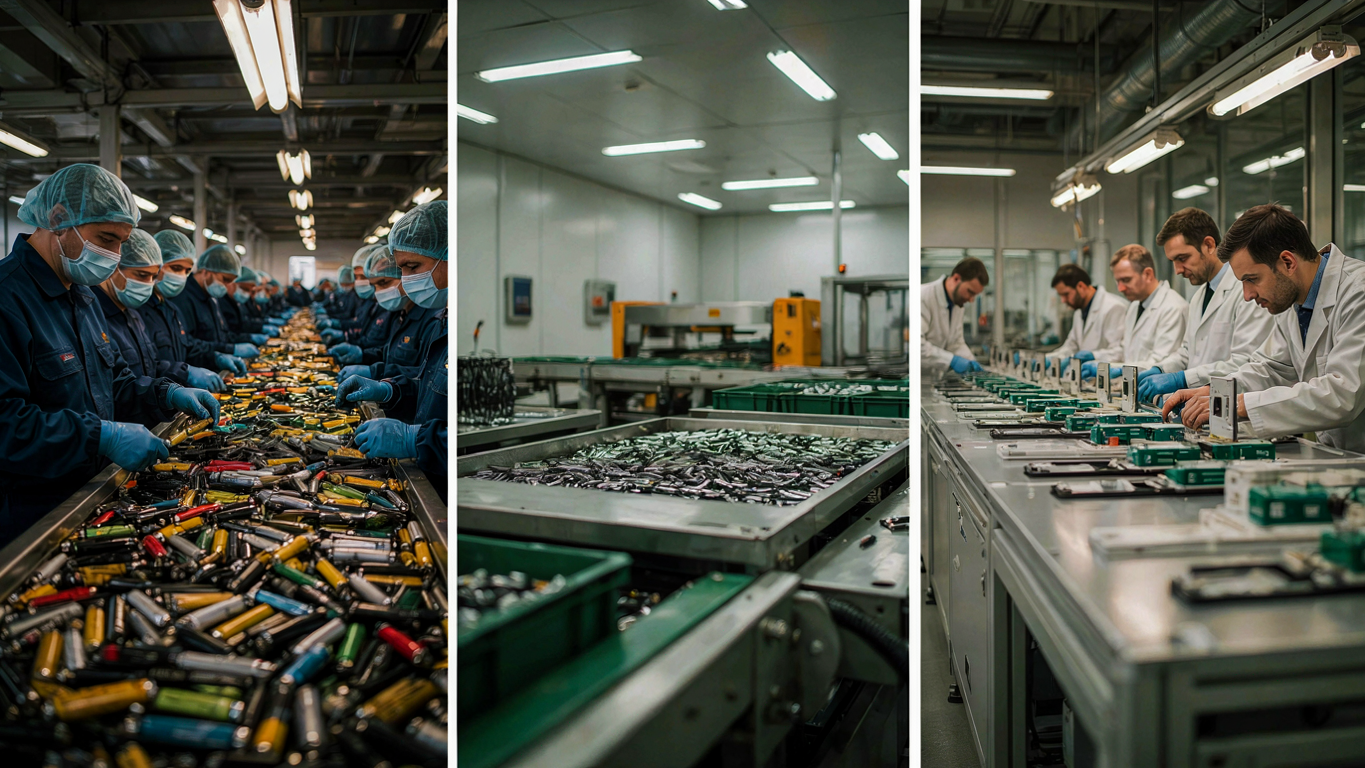
Manufacturing scrap currently dominates feedstock availability for battery recycling, accounting for two-thirds of available material through 2030. This abundant supply enables recycling operators establish operational capacity and refine processes before end-of-life battery availability peaks in later years. Companies deploying advanced recycling infrastructure immediately access manufacturing scrap from battery cell producers, creating rapid revenue generation and operational maturity competitors entering markets later cannot achieve.
From 2035 onwards, end-of-life EV and storage batteries transition to becoming the primary feedstock source, representing over 90% of available material by 2050. Companies establishing recycling partnerships with battery manufacturers by 2026-2027 secure long-term supply relationships spanning both manufacturing scrap (immediate, high-volume) and end-of-life battery streams (growing volumes through 2040s). This structural feedstock advantage creates defensible competitive positions in EU stockpiling and supply chain resilience markets.
Advanced Recycling Technology as Competitive Advantage
The core constraint limiting EU participation in stockpiling programs is processing capacity meeting battery-grade material specifications. Hydrometallurgical methods are expected to become the dominant recycling approach in Europe due to superior efficiency in recovering valuable materials, particularly given growing demand for critical minerals where contamination or purity deficits make materials unsuitable for direct battery manufacturing. Advanced hydrometallurgical technology enabling direct processing of unsorted black mass into precursor cathode active material (pCAM) of 99%+ purity creates competitive advantage competitors relying on conventional pyrometallurgical or multi-step hydrometallurgical processes cannot replicate.
Recovery rates for nickel, cobalt, and copper reach 95% through advanced hydrometallurgical methods. Lithium recovery achieves 80%+ efficiency through optimized processes. These recovery rates enable recyclers achieve material yields satisfying both regulatory mandates and economic viability. Technologies processing black mass directly into battery-grade materials without requiring secondary refining steps reduce operational complexity, lower energy consumption, and accelerate time-to-revenue compared to conventional recycling approaches.
Green Li-ion's modular battery recycling approach exemplifies how advanced hydrometallurgical technology enables companies participate in stockpiling initiatives. The technology converts unsorted black mass directly into battery-grade pCAM and other essential components without multi-step processing requiring secondary facilities. This efficiency advantage translates to operational speed enabling recyclers deploy capacity in months rather than years, achieving profitability faster than competitors building conventional facilities, and scaling supply volumes matching government and manufacturer purchasing commitments.
Supply Chain Integration: From Collection to Government Stockpiles
Companies capitalizing on EU stockpiling opportunities require integrated supply chain approaches spanning collection, preprocessing, advanced recycling, and direct supply to stockpiling agencies or battery manufacturers. This vertical integration eliminates intermediary markups and supply chain complexity traditional models impose. Battery manufacturers requiring recycled materials for regulatory compliance purchase directly from recyclers achieving sufficient scale and material consistency. Government stockpiling agencies prefer integrated suppliers demonstrating supply chain control and material specification compliance.
Integrated recycling operators establish collection networks capturing manufacturing scrap from battery cell producers and coordinating EV dismantling partnerships ensuring consistent feedstock supply. Closed-loop lithium recovery systems reduce supply chain dependence on foreign minerals while establishing domestic processing capacity countries reward through preferential purchasing and policy support. Rather than competing for scrap in commodity markets, integrated operators secure long-term supply agreements with battery manufacturers and recycling partners, creating feedstock stability enabling capacity investment and operational scaling.
Advanced recycling technology enabling direct processing of diverse battery chemistries creates supply chain advantage. Manufacturers designing batteries for multiple end-markets (EVs, stationary storage, light transport) generate mixed chemistry scrap. Conventional recycling requires pre-sorting by chemistry before processing, adding cost and complexity. Advanced hydrometallurgical technology enables feedstock supply regardless of chemistry mix, simplifying collection logistics and reducing preprocessing requirements competitors cannot avoid.
Regulatory Timeline and Competitive Positioning Through 2030
The EU policy timeline creates specific competitive windows. Q1 2026 pilot stockpiling scheme launch establishes operational procedures and supply protocols. Battery manufacturers must document 6% cobalt, 6% lithium, and 6% nickel recycled content by 2031. Collection targets of 63% portable batteries and 90% recovery efficiency for critical materials require infrastructure deployment by late 2027. Companies establishing recycling partnerships and supply chain integration by mid-2026 achieve operational maturity and supplier relationships critical for meeting 2027-2028 compliance deadlines.
Permitting acceleration for strategic projects reduces facility deployment timelines to 15 months for processing and recycling operations. This compressed timeline rewards companies executing immediately. Manufacturers delaying investment face timeline pressure competing for limited feedstock under deadline constraints. Early movers establishing partnerships secure preferential offtake agreements and government purchasing commitments competitors cannot access under deadline-driven negotiation dynamics.
The RESourceEU Centre's matchmaking platform launches March 2026 round one. Companies registering recycling capacity and material specifications gain access to demand aggregation identifying battery manufacturers requiring supplies meeting specific volume, timeline, and purity commitments. Recyclers entering this matching process with operational capacity gain competitive advantage. Those still deploying facilities face delayed market access and constrained purchasing channel availability.
Financing and De-risking Mechanisms for Recycling Investment
EU policy frameworks mobilizing €3 billion in direct funding and de-risking mechanisms specifically support recycling infrastructure investment. InvestEU mobilizes up to €2 billion of investments across the critical materials value chain. Battery Booster dedicates €300 million to upstream raw materials projects. Innovation Fund allocates €700 million in the 2026 call for critical raw materials and clean technology integration. These programs provide grants, below-market financing, and equity de-risking enabling recyclers achieve investment returns in timescales competitors relying on commercial capital cannot match.
Fast-tracked permitting through CRMA procedures compresses project timelines from 36+ months to 15 months for recycling operations. This acceleration reduces development cost and enables earlier revenue generation. Strategic Projects approved under CRMA receive priority access to EU financing instruments and member state support. Companies structuring facilities as Strategic Projects gain funding advantages and permitting acceleration competitors operating under standard commercial development procedures cannot replicate.
Supply Chain Resilience and Competitive Advantage
Beyond government stockpiling, companies supplying recycled materials establish competitive advantages with battery manufacturers seeking supply chain resilience and reduced geopolitical vulnerability. Manufacturers depending entirely on virgin material imports face margin compression as supply scarcity drives prices upward. Those securing recycled content supply agreements with domestic European recyclers gain cost stability and supply certainty enabling pricing discipline competitors lack.
Recycled content also creates customer preference. EV manufacturers and battery producers demonstrating domestically sourced materials and circular economy integration differentiate from competitors dependent on contested supply chains. This customer advantage translates to volume contracts and premium pricing enabling recyclers achieve superior margins competitors pursuing commodity market strategies cannot match.
Conclusion: Participation vs. Dependence
European critical materials stockpiling initiatives create structural advantage for companies deploying advanced recycling technology capable of supplying materials meeting regulatory and commercial specifications. The EU's policy commitment to domestic supply chain resilience guarantees demand for recycled materials through 2030+ in ways virgin material markets cannot. Manufacturers requiring recycled content will purchase from recyclers offering supply certainty, material consistency, and cost stability.
Companies establishing partnerships immediately, deploying advanced recycling infrastructure, and integrating with EU supply chain resilience frameworks position themselves advantageously for long-term competitive positioning. Those delaying investment face timeline pressure, limited market access, and constrained financing availability competitors entering early cannot impose. The competitive window for supply chain integration spans 2026-2027. Organizations executing within this timeframe establish defensible positions. Those waiting compete for remaining capacity under deadline pressure.
European strategic autonomy in critical materials depends on domestic recycling capacity supplied by advanced technology operators. Companies enabling this strategic transition through infrastructure deployment and supply chain integration gain competitive advantage determining market leadership through 2030 and beyond.

.svg)