
.png)
India stands at a critical juncture in its energy transition. With aggressive targets to deploy 100 million electric vehicles by 2030 and commitments to net-zero emissions by 2070, the nation's battery supply chain has become a strategic priority for national security, economic growth, and environmental sustainability. Yet India faces a fundamental challenge: near-total dependence on imported critical minerals essential for battery production. This vulnerability threatens India's clean energy ambitions and exposes manufacturers to geopolitical supply disruptions. Advanced recycling technologies like Green Li-ion's hydrorejuvenation process offer a transformative pathway to address this crisis by enabling domestic production of battery-grade materials from end-of-life batteries. Understanding how these technologies can help India build a resilient, sustainable battery supply chain is essential for policymakers, manufacturers, and investors shaping the nation's energy future.
India's Battery Supply Chain Crisis: Import Dependency and Strategic Vulnerability
India's lithium-ion battery manufacturing sector faces an unprecedented supply chain challenge. The nation currently relies on imports for nearly 100% of critical minerals essential for battery production, including lithium, cobalt, and nickel. According to government analysis of critical mineral imports for electric vehicles, India's demand for these materials continues rising exponentially as EV adoption accelerates. The government has identified this dependency as a strategic vulnerability requiring urgent intervention through the National Critical Mineral Mission (NCMM), which allocated Rs 16,300 crore to strengthen critical mineral value chains across exploration, mining, beneficiation, processing, and recovery from end-of-life products.
Current import patterns expose Indian manufacturers to significant risks. Research organizations analyzing India's mineral sourcing strategies document that lithium supplies remain concentrated among a small number of producing countries, while cobalt extraction depends heavily on politically unstable regions. This geographic concentration creates chokepoints vulnerable to geopolitical disruption, price volatility, and supply shocks that threaten India's ability to meet 2030 EV targets. For context, India's annual lithium imports cost approximately $2.5 billion, while total critical mineral imports reached $8.01 billion in 2023-24, more than doubling from $3.03 billion in 2020-21.
The scale of future demand amplifies these vulnerabilities. India's lithium-ion battery manufacturing industry requires approximately 193,000 tons per year of cathode active material, 98,000 tons of anode material, and significant quantities of lithium, nickel, and cobalt to achieve 100 GWh annual production by 2030. Meeting this demand through imports alone would create unsustainable costs and supply chain fragility. This reality has prompted the Indian government to pursue multiple strategies: overseas mineral acquisitions through Khanij Bidesh India Limited (KABIL), domestic mineral exploration and mining expansion, and critically, the development of advanced battery recycling infrastructure to recover these materials from end-of-life batteries currently accumulating in the market.
The Recycling Opportunity: India's Hidden Mineral Reserve
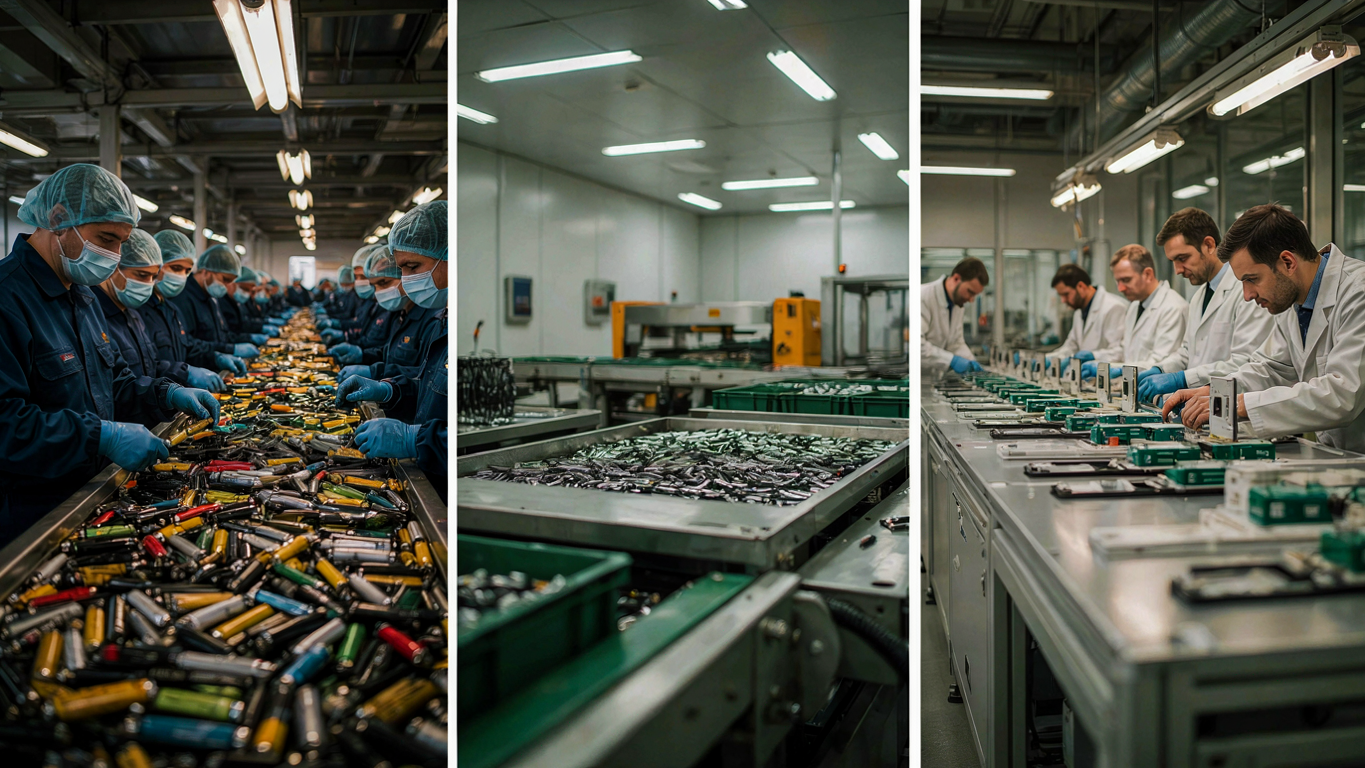
India's emerging battery recycling sector represents an underutilized but strategically significant source of critical materials. Analysis of India's EV battery recycling ecosystem reveals that the nation expects approximately 128 gigawatt-hours of end-of-life lithium-ion batteries available for recycling by 2030, with EV batteries constituting 46% of this total. This represents an enormous "urban mining" opportunity that could reduce India's reliance on primary mineral extraction and overseas supply chains.
The economic case for recycling is compelling. Advanced recycling technologies can recover 95-99% of critical materials including lithium, cobalt, and nickel from spent batteries. When processed through modern hydrometallurgical methods, these recovered materials achieve battery-grade purity suitable for immediate reuse in new battery manufacturing. Research indicates that recycled materials can supply 30-40% of India's lithium demand by 2030, fundamentally reducing import dependence and strengthening price and supply security. Additionally, recovered materials cost 30-50% less than primary minerals, creating cost advantages that benefit Indian battery manufacturers competing in global markets.
Current recycling capacity, however, falls far short of future needs. Industry analysis of India's battery recycling sector in 2025 reveals that while India has developed recycling facilities capable of processing approximately 60,000 tonnes annually, the projected 2 million tons of battery waste by 2035 requires capacity expansion of approximately 33 times current levels. This gap represents a critical infrastructure challenge that must be addressed through significant capital investment, advanced technology deployment, and policy support. Here, purpose-built recycling technologies become essential infrastructure for closing this capacity gap.
How Advanced Hydrometallurgical Technology Addresses India's Supply Chain Gap
Green Li-ion's proprietary hydrorejuvenation technology offers a scalable solution specifically designed for the high-volume processing India requires. Unlike traditional pyrometallurgical methods requiring extensive energy input and specialized smelting infrastructure, hydrometallurgical recycling uses chemical leaching to dissolve valuable materials from spent batteries into solutions where they can be separated and recovered with exceptional precision. This approach accounts for over 95% of advanced recycling capacity globally and is particularly suited for India's manufacturing environment.
The technology's core advantage lies in speed and efficiency. Where conventional recycling methods require weeks of processing, hydrometallurgical systems convert black mass directly into battery-grade precursor cathode active material (pCAM) in approximately 12 hours. This dramatic acceleration reduces working capital requirements, improves facility utilization, and enables rapid scaling to meet India's growing end-of-life battery volumes. The process recovers lithium, cobalt, and nickel at 95-99% efficiency, producing materials meeting strict battery manufacturer specifications without further refinement or overseas processing.
Modular deployment is particularly advantageous for India's manufacturing ecosystem. Rather than requiring massive centralized recycling megafacilities requiring years to construct and billions in capital investment, modular recycling technology enables integration into existing manufacturing sites and battery assembly facilities. This approach allows Indian battery manufacturers, automotive OEMs, and specialized recyclers to establish on-site processing capabilities within months rather than years. For manufacturers, this means gaining direct control over critical mineral supplies, reducing dependence on external recycling partners and improving supply chain resilience. The environmental benefits complement economic advantages: hydrometallurgical recycling reduces greenhouse gas emissions by 80% compared to primary mining operations, supporting India's climate commitments while securing materials.
Policy Framework and Government Support Enabling Technology Deployment
India's government has established a favorable policy environment for recycling infrastructure development. The Battery Waste Management Rules 2022 implement Extended Producer Responsibility (EPR) frameworks requiring battery manufacturers to assume accountability for full lifecycle management, including collection and recycling targets. The Union Budget 2025-26 announced multiple measures supporting battery recycling and critical mineral processing, including exemption of basic customs duty on lithium-ion battery waste, cobalt powder, and 12 additional critical minerals. This tariff structure directly reduces landed costs for recyclers processing imported scrap and incentivizes domestic refining rather than overseas material export.
Additionally, the National Critical Mineral Mission provides Rs 1,500 crore in dedicated incentives for domestic recovery of critical minerals from secondary sources like batteries. Government procurement commitments through Extended Producer Responsibility frameworks create guaranteed demand for recycled materials, reducing market uncertainty for investors developing recycling infrastructure. State-level incentives in manufacturing-focused regions like Karnataka, Maharashtra, and Tamil Nadu offer additional subsidies and policy support for establishing advanced recycling facilities.
These policy initiatives create immediate market opportunities for technology providers and recyclers willing to deploy advanced systems. Indian battery manufacturers and automotive OEMs increasingly recognize recycling partnerships as strategic assets enabling supply chain control and compliance with evolving global regulations. Government and corporate support for battery recycling signals recognition that a resilient Indian battery supply chain requires domestic processing infrastructure capable of meeting 128 GWh end-of-life battery volumes projected for 2030.
Market Opportunity: Scale, Growth, and Economic Multipliers
India's battery recycling market demonstrates exceptional growth potential. Current market size stands at approximately $150-550 million, with projections reaching $230-1,300 million by 2030-2033, representing compound annual growth rates of 8-9%. These growth rates significantly exceed global averages, reflecting India's unique combination of explosive EV adoption, rising end-of-life battery volumes, and government policy prioritization of recycling infrastructure.
Beyond direct revenue opportunity, recycling infrastructure creates substantial economic multipliers. The Department of Energy announced similar scale investments in United States battery recycling created over 8,000 construction jobs and 4,000 operating positions per $3 billion in federal support. Applied to India's manufacturing scale and labor economics, comparable investments in recycling infrastructure could generate tens of thousands of skilled manufacturing and technical positions while supporting complementary industries across battery material supply chains. Local sourcing commitments by recycling operators strengthen regional manufacturing ecosystems and attract downstream battery cell and pack manufacturers seeking integrated supply sources.
Critical Success Factors: Integration, Capacity, and Ecosystem Development
Successfully deploying advanced recycling technology in India requires addressing several critical factors beyond technology selection. First, reverse logistics infrastructure for battery collection remains underdeveloped. Establishing robust collection networks spanning automotive manufacturers, fleet operators, and informal recyclers ensures steady feedstock supply for processing facilities. Government coordination of collection programs, as mandated through Extended Producer Responsibility frameworks, becomes essential for achieving the 128 GWh recycling target.
Second, workforce development and technical training must accompany technology deployment. Hydrometallurgical recycling requires skilled operators, maintenance personnel, and quality control specialists trained in chemical processing and material characterization. Partnerships between recycling operators and educational institutions, vocational training centers, and technical universities can build local capacity while creating employment pathways for Indian workers.
Third, standardization of battery chemistry tracking and data management systems enhances recycling efficiency. A proposed "Battery Aadhaar" system tracking manufacturing origin, chemistry, safety certification, and lifecycle performance would enable predictive maintenance and optimized recycling strategies. Digital infrastructure enabling information sharing between automotive manufacturers, battery assemblers, recyclers, and government agencies improves material flow visibility and recycling planning accuracy.
Competitive Positioning: Alternative to Import Dependency
India's ability to develop domestic battery recycling capacity directly impacts its competitive positioning in the global EV market. Nations achieving vertical integration across battery manufacturing, recycling, and critical mineral processing create cost advantages and supply security unavailable to import-dependent competitors. Recycling directly addresses supply chain vulnerabilities by providing domestic material sources, enabling Indian battery manufacturers to offer pricing and supply reliability advantages over competitors reliant on primary mineral imports.
For Indian battery manufacturers and automotive OEMs, advanced recycling technology deployment becomes a strategic competitive necessity rather than an optional sustainability initiative. Early adopters establishing closed-loop recycling infrastructure secure cost advantages, supply chain control, and regulatory compliance positions that accelerate growth and market share capture as EV demand accelerates.
Pathway Forward: Technology Deployment and Investment Strategy
India's transition to a sustainable, import-independent battery supply chain requires strategic technology deployment beginning immediately. Early-stage investments in advanced recycling facilities using modular, proven hydrometallurgical systems can establish operational proof points and build technical expertise across Indian manufacturing and recycling sectors. Government support through National Critical Mineral Mission incentives, customs duty exemptions, and procurement commitments creates favorable conditions for attracting both domestic and international investment capital.
Technology partners and investors with proven hydrometallurgical recycling systems can accelerate India's capability building by establishing joint ventures, licensing agreements, or direct facility operations in key manufacturing regions. Training programs transferring technical expertise to Indian technicians and engineers build long-term domestic capacity while supporting technology localization and adaptation to Indian battery chemistry variations and market requirements.
For India to achieve its 2030 EV targets while securing supply chain resilience and achieving net-zero commitments, domestic battery recycling infrastructure development must become a national priority receiving capital investment, policy support, and technology focus equal to that directed toward primary mineral exploration and international acquisition agreements. Advanced hydrometallurgical technologies provide proven solutions for converting India's growing end-of-life battery streams into strategic mineral sources, reducing import dependency, and building a sustainable battery supply chain supporting India's clean energy future.

.svg)