
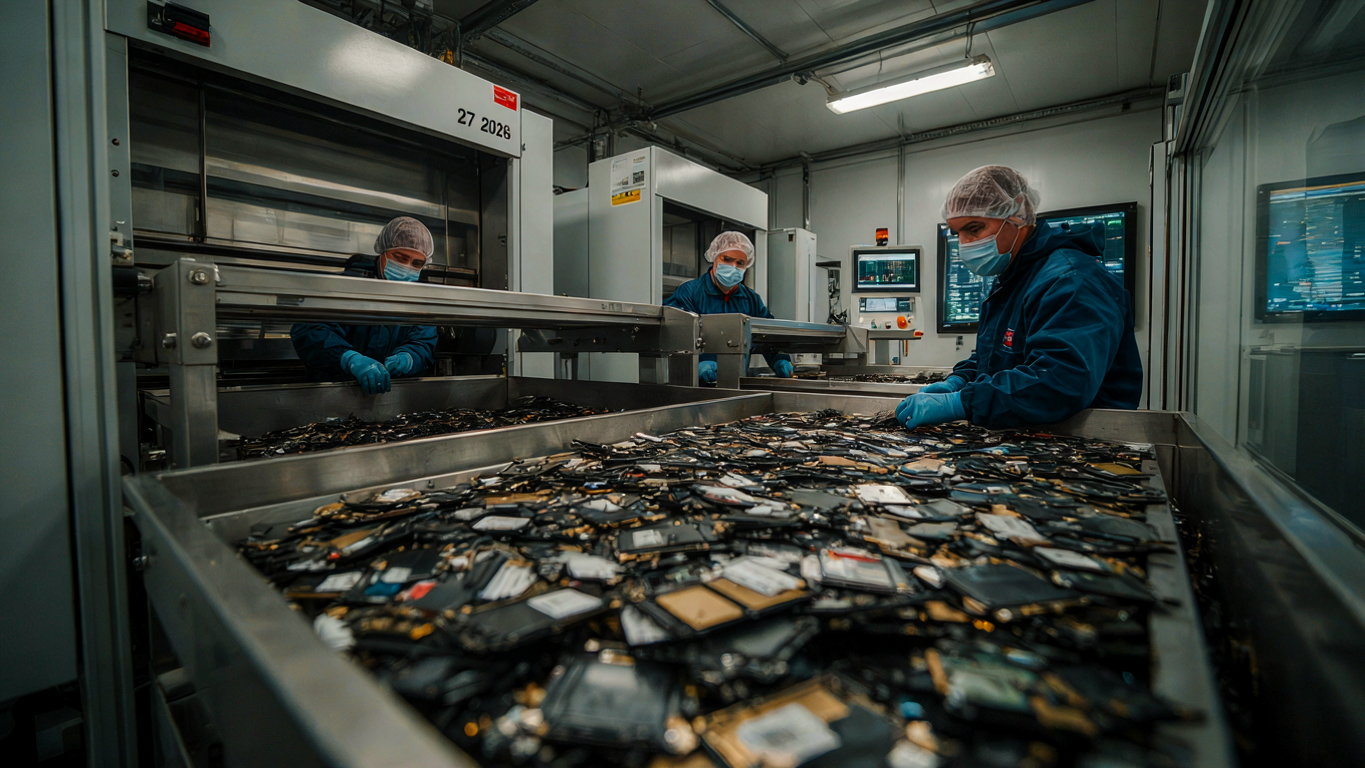
On August 4, 2026, the Bureau of Industry and Security filed a temporary final rule with the Federal Register that implements one of the most consequential single regulatory actions the US battery recycling industry has ever faced. The black mass export restrictions take effect on August 27, 2026, twenty-one days after publication, and require U.S. persons engaged in the sale of black mass to allocate 100 percent of monthly sales to U.S. persons unless the Bureau grants a case-by-case exception. The rule runs for 386 days from publication. This piece unpacks what the temporary final rule actually says, what it does not do, what the exception process looks like, and why domestic post-treatment refining just moved from a commercial preference to a regulatory necessity for anyone with a stake in the US black mass export restrictions compliance environment.
What the BIS Directive Allocation Order Actually Does
The temporary final rule, published under Docket No. 260804-0143 and RIN 0694-AK51, invokes the Defense Priorities and Allocations System at 15 CFR Part 700 to issue a Directive Allocation Order. The legal authority chain runs from Section 101 of the Defense Production Act of 1950 through Executive Order 13603 through the July 30, 2026 Presidential Determination on Recoverable Critical Minerals and Materials, and finally to this Bureau of Industry and Security implementing rule. The mechanism is a domestic sales requirement rather than an outright export ban or licensing regime. U.S. persons who sell black mass must allocate 100 percent of their monthly sales to U.S. persons, with the practical effect that black mass must remain physically located within the United States unless the Bureau authorizes an exception.
The rule also covers tungsten waste and scrap under Schedule B code 8101.97.00.00, subject to the same 100 percent domestic sales requirement. For battery recycling specifically, the covered black mass codes are Schedule B 8549.13.00.00 (electrical and electronic waste and scrap, sorted, not containing lead, cadmium, or mercury), 8549.14.00.00 (unsorted, not containing lead, cadmium, or mercury), and 8549.19.00.00 (other). The Bureau clarified that the domestic sales requirement applies to material under these Schedule B codes only if it meets the rule's specific definition of black mass. Material under those codes that does not meet the definition is not subject to the order.
The temporary rule is exempt from the ordinary Administrative Procedures Act notice-and-comment requirements. The Bureau invoked the Section 709(b)(2) exemption on the finding that "urgent and compelling circumstances make compliance with prior notice and opportunity for public comment impracticable." Public comments on the black mass export restrictions are still being solicited, with a 90-day window running through regulations.gov (BIS-2026-0364). Any provisions of the rule that survive the comment period without expiration or amendment will become final at that point.
The Precise Legal Definition of the Black Mass Export Restrictions
The single most important paragraph in the Bureau's supplement to Part 700 is the definition of "black mass" at paragraph (b) of Supplement No. 1. The primary text reads: "'Black mass' means any shredded lithium-ion battery scrap that contains cathode material (which may include aluminum, copper, iron, lithium, cobalt, nickel, and manganese), anode material (graphite, silicon) or other residual battery cell materials." Everything that follows in the compliance mechanics, the exception process, and the enforcement infrastructure applies only to material that meets this definition.
Three attributes of that definition matter for interpreting the scope of the black mass export restrictions. First, the material must be shredded. Whole end-of-life batteries and pack assemblies that have not yet been through mechanical processing are not black mass under this rule, though they may become black mass once shredded. Second, the material must derive from lithium-ion battery scrap. Nickel-metal-hydride, lead-acid, and other chemistries fall outside the definition. Third, the material must contain cathode material, anode material, or "other residual battery cell materials." The cathode metals list is comprehensive and includes aluminum, copper, iron, lithium, cobalt, nickel, and manganese. The anode list explicitly includes graphite and silicon.
What the definition does not cover is equally important. Freshly refined precursor cathode active material, battery-grade lithium carbonate, NCM hydroxide, and recovered graphite produced through domestic post-treatment refining are not "shredded lithium-ion battery scrap." They are finished battery-grade materials that have completed the refining step and are ready for cell manufacturing. The black mass export restrictions do not apply to these finished outputs. A domestic recycler that converts black mass into finished battery-grade material inside the United States and then sells that finished material into cell manufacturing, whether US-domestic or allied, sits above the restriction line the Bureau just drew.
What "Domestic Sales Requirement" Means for Black Mass Producers
Beginning August 27, 2026, any U.S. person selling covered black mass must direct 100 percent of monthly sales to U.S. persons. The rule defines a "U.S. person" as any individual, corporation, partnership, association, or organized group located in the United States. Sales include transactions in any US state, territory, or possession, as well as deliveries between affiliates or subsidiaries and internal deliveries within a single entity across branches or divisions. The scope of the sales requirement is comprehensive.
Enforcement is real. The Bureau will coordinate implementation of the black mass export restrictions with U.S. Customs and Border Protection, which is authorized to detain covered materials at export while the Bureau conducts review. Any goods detained by CBP that become subject to a DPAS rated order will be consigned to the Bureau pending further distribution or agency direction. The Bureau retains investigation authority under 15 CFR 700.71 and injunction authority under 15 CFR 700.74(b), with civil penalties available for noncompliance under Section 103 of the DPA.
The practical implication for the current US battery recycling supply chain is significant. Fastmarkets documented in mid-2024 that a substantial share of US-origin NCM black mass was moving to Korean refiners at spot deals transacting at 68 to 75 percent CIF Korea payables for nickel and cobalt. That outbound flow now needs a Bureau exception, and the payable structure that made shred-and-ship economics work is exposed to a new regulatory friction that did not exist a week ago. Domestic black mass generated by US shredders, cell manufacturing production scrap operations, and end-of-life battery collection programs must find a domestic buyer or an exception grant before it can leave the country.
The Exception Regime: Where Offshore Refining Remains Legal
The black mass export restrictions do not eliminate offshore black mass processing entirely. Paragraph (c) of Supplement No. 1 preserves an exception pathway for U.S. persons who need to move covered material outside the sales requirement. The Bureau will consider exception requests on grounds including undue or exceptional hardship, consequences contrary to the DPA's intent (for example, a compliance obligation that would reduce rather than increase domestic supply of critical mineral materials), and the tolling carve-out that matters most for recyclers with existing offshore relationships.
The tolling carve-out is worded explicitly: the Bureau will consider exceptions where "a U.S. person plans to sell black mass and tungsten waste and scrap to a person located outside the United States for processing or refining, and then the processed/refined material will be returned to the United States." Offshore refining under a tolling arrangement is permissible if the finished material comes back to US soil. Offshore refining that terminates in a Korean, Chinese, or European cell manufacturing supply chain without US reimport is not preserved by this carve-out.
Exception requests must be submitted in writing to DPASAllocations@bis.doc.gov and must include a complete statement of facts and circumstances, a precise statement of reasons why relief should be provided, and supporting documentation. The Bureau intends to respond within 14 days of receipt. The submission of a request does not relieve any U.S. person from the obligation to comply with the sales requirement while the request is pending, unless interim relief is granted in writing. The Bureau retains discretion to authorize a DPAS temporary license as interim relief.
Two operational implications sit under this exception structure. First, the burden of proof is on the exporter, and the intended 14-day response window is not a guaranteed timeline. Second, exception grants are case-by-case at Bureau discretion. Companies that have historically operated under stable offshore refining arrangements now need to plan around either domestic redirection of black mass supply or a bureaucratic process that may or may not preserve their existing business model.
Why Post-Treatment Refining Sits Outside the Restriction
The black mass export restrictions are precisely targeted at the recoverable feedstock stream flowing out of the United States, not at the finished output of domestic refining. This distinction is the entire commercial hinge of the rule. Domestic recyclers that finish black mass into battery-grade materials on US soil produce output that is not covered by the rule at all. That output can be sold into US cell manufacturing, into EU cell manufacturing that requires recycled content under Battery Regulation 2023/1542, into Korean and Japanese cell producers looking for non-Chinese refining routes, or into any other market the recycler chooses to serve.
Green Li-ion's GREEN HYDROREJUVENATION™ process at Atoka, Oklahoma converts unsorted black mass directly into 99% pure precursor cathode active material, battery-grade lithium carbonate, and recovered graphite through modular processing lines running at 730 metric tonnes per year per line. The Atoka facility is one of the small number of operational commercial-scale post-treatment refining sites in North America today, and the type of U.S. person the Bureau's rule is designed to allocate domestic black mass supply toward. The August 3 sister article on recoverable critical minerals and post-treatment refining as a structural advantage anticipated exactly this outcome. The rule as published confirms it.
The commercial dynamic that emerges from the black mass export restrictions is straightforward. Historically, US black mass generators had a choice between selling to a US refiner or exporting to a Korean or Chinese refiner. The economics of shred-and-ship models depended on that outbound flow. As of August 27, 2026, that choice is regulatorily constrained. Black mass sold in the US must go to a U.S. person unless the Bureau authorizes otherwise. The pool of US-domiciled buyers who can convert black mass into finished battery-grade output is small enough that the demand-supply balance for domestic black mass now shifts materially in favor of the buyers who exist. Green Li-ion is one of those buyers.
What Battery Recyclers, OEMs, and Cell Manufacturers Should Do Before August 27
The 21-day window between publication and effective date is short. For every organization with a stake in the US battery recycling supply chain, several practical actions are worth taking now rather than after enforcement begins.
For shredders and mechanical processors currently generating black mass for offshore refining customers: existing sales agreements that anticipate export delivery need to be reviewed for compliance risk. Any monthly sale of covered black mass to a non-U.S. person after August 27 requires an approved Bureau exception. Applications should be prepared and submitted in the pre-effective-date window if the underlying business model depends on continued offshore flow. The Bureau's exception framework prioritizes the tolling carve-out, so recyclers whose offshore arrangements terminate in reimported finished material have a clearer pathway than those whose material terminates in an offshore cell manufacturing supply chain.
For cell manufacturers and OEMs with recycled feedstock supply agreements: review whether your recycler's business model depends on exports that now require Bureau authorization. If your recycler is one of the operational domestic post-treatment refiners producing finished battery-grade material inside the United States, your supply arrangement is not directly affected by the rule and may benefit from a demand-supply shift as offshore competition for domestic black mass constricts. If your recycler's model is shred-and-ship with offshore finishing, verify the exception strategy before August 27.
For battery manufacturers evaluating new recycling partnerships in the coming months, the strategic criteria have narrowed. Procurement teams ready to evaluate domestic post-treatment refining capacity can begin partnership conversations with qualified recyclers such as Green Li-ion, whose GREEN HYDROREJUVENATION™ lines at Atoka process black mass directly into finished pCAM and lithium carbonate at 730 metric tonnes per year per modular line under a binding offtake agreement with commodity trader WMC through 2030, and whose NCM hydroxide produced from American-recycled raw materials has been listed on the Metalshub platform for direct commercial sale. The company operates lines with a presence across the US, Singapore, Korea, Germany, and Australia, which matters for OEMs coordinating recycled supply across their global manufacturing footprint under a regulatory environment that now differentiates finished domestic output from shredded exportable feedstock.
Public comment strategy also matters for anyone with a policy position on the black mass export restrictions. Comments are due 90 days after the August 6 publication date via regulations.gov under Docket ID BIS-2026-0364 and RIN 0694-AK51. The comment period will shape how the rule is refined or extended past its 386-day expiration.
The Honest Summary
The temporary final rule the Bureau of Industry and Security published on August 6, 2026 is not a symbolic regulatory action. It is a specific, enforceable, immediately effective allocation order that requires U.S. persons selling black mass to direct 100 percent of monthly sales to U.S. persons for the next 386 days, subject to a limited exception regime and enforced by U.S. Customs and Border Protection at the point of export. The black mass export restrictions are now the operating reality of the US battery recycling supply chain, and every commercial arrangement in the sector needs to be evaluated against them.
The rule's scope is bounded by the Bureau's precise definition of black mass as shredded lithium-ion battery scrap. Finished battery-grade materials produced through domestic post-treatment refining are not covered. That distinction is the entire commercial hinge. Recyclers whose model finishes the material on domestic soil sit above the restriction line and benefit from the demand-supply shift the rule creates. Recyclers whose model depends on exporting shredded feedstock for offshore finishing need to either restructure into a tolling-and-reimport arrangement, secure a Bureau exception, or accept the loss of their historical outbound channel. Green Li-ion's GREEN HYDROREJUVENATION™ technology at Atoka is one operational example of the finishing model the rule is structured to allocate supply toward, and the 21-day window before the August 27 effective date is the last opportunity for the industry to plan around the new reality on the industry's own timeline rather than the Bureau's enforcement calendar.
The details are no longer TBD. The rule is written. The clock is running.


.svg)