
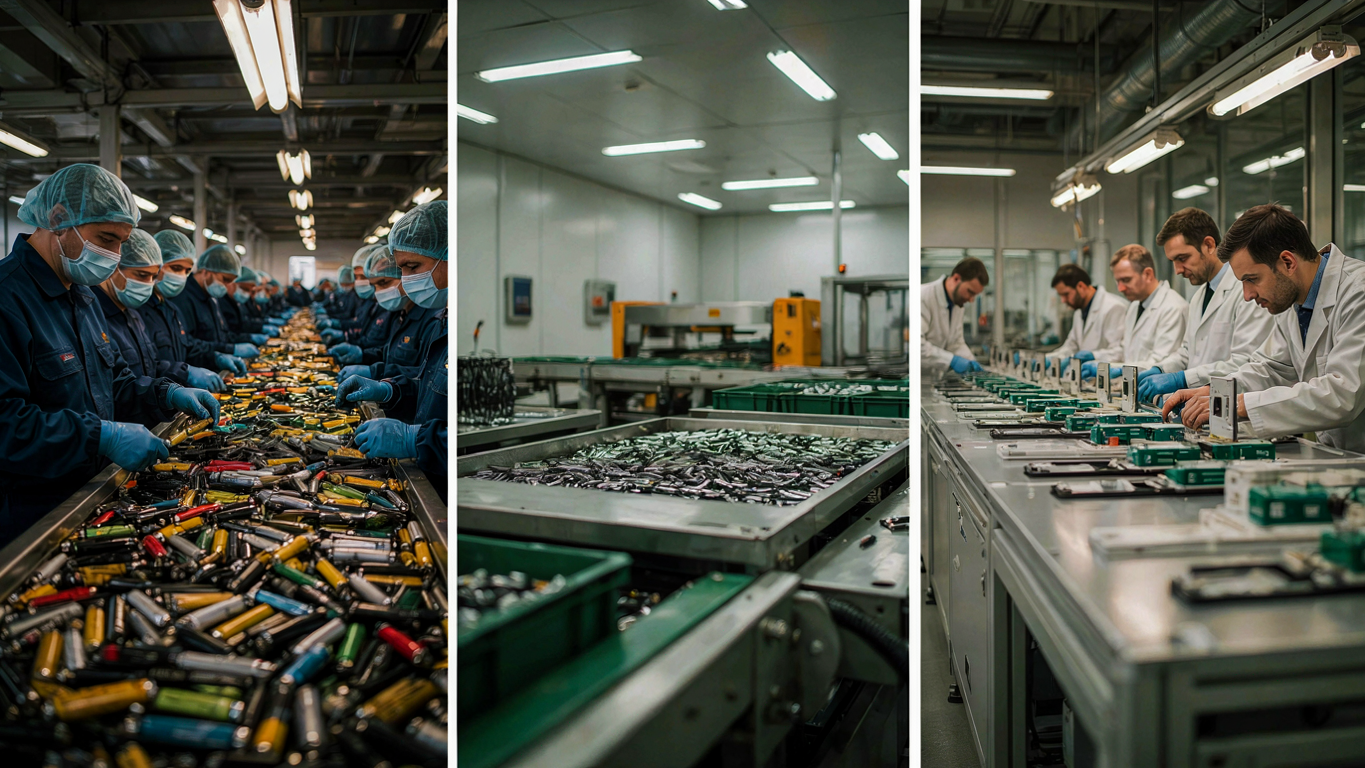
On August 20, 2026, the Department of Energy's Office of Critical Minerals and Energy Innovation announced $500 million for seven selected projects. The money expands critical mineral and material processing, battery manufacturing, and recycling capacity in the United States. The detail worth holding onto is that all three of those activities sit in one announcement, funded through one office, under one rationale. The DOE battery recycling award is not a recycling program. It is a supply chain program in which recycling is one of three funded stages.
That framing matters because recycling is often discussed as though it competes with domestic mining for the same policy attention. The structure of this award says otherwise.
Talk to Green Li-ion
For Green Li-ion technology inquiries, sales discussions, and collaboration opportunities, contact Matthew Cooper, VP of Business Development, USA and China.
Connect with Matthew on LinkedIn or contact Green Li-ion directly.
What the DOE Battery Recycling Award Actually Funds
The announcement identifies $500 million for seven projects. It describes the money as expanding critical mineral and material processing, battery manufacturing, and recycling capacity, and it notes that the selected projects include demonstration projects, construction of commercial-scale facilities, and retrofitting or retooling of existing facilities.
The Department describes this as the third round of funding from two of its programs, the Battery Materials Processing program and the Battery Manufacturing and Recycling program. Both sit under the Office of Critical Minerals and Energy Innovation. The award is not a new initiative reacting to a single event. It is the continuation of an established funding line.
The individual project names and their award amounts are not listed in the announcement itself. The Department points to its two program pages for that detail. This article does not identify the recipients, because the primary announcement does not, and attributing awards without the underlying list would be guesswork.
Three Stages, One Program
The useful structure here is the pairing of activities inside a single instrument.
Processing takes mined or recovered material and converts it into refined units. Manufacturing turns those units into cells. Recycling recovers material from scrap and end-of-life batteries and returns it to the processing stage. In the DOE announcement these are not three competing claims on a fixed pool. They are three parts of one supply chain, each funded because the chain needs all of them.
That is consistent with how the underlying categories are defined. Lithium, cobalt, nickel, manganese, and graphite are designated critical minerals or critical materials, and recovered units sit in the same commodity category as mined units, a structure we work through in our analysis of critical minerals versus critical materials. The designation attaches to the material, not to whether it came out of the ground or out of a battery. A funding program aimed at securing those commodities has no reason to prefer one source over the other, and this one does not.
Why the Timing Sits Next to the Export Rule
The award landed within the same month as the effective date of a separate measure that also keeps recyclable material onshore.
The Bureau of Industry and Security's Directive Allocation Order took effect on August 27, 2026, requiring domestically generated black mass to be sold to United States buyers. We cover its mechanics in our breakdown of the BIS Directive Allocation Order, and the resulting constraint on domestic refining in our analysis of US black mass processing capacity.
The two instruments do different work and are not formally connected, but they point in the same direction. One keeps the feedstock inside the country. The other funds capacity to process material inside the country. A policy environment that traps black mass domestically and simultaneously funds domestic processing capacity is coherent in a way that a single measure on its own is not. The export rule creates the captive feedstock. Programs like this one help build the capacity to use it.
That said, this is an observation about direction rather than coordination. Nothing in the DOE announcement references the BIS rule, and reading a single strategy into two instruments from two agencies would be assuming more than the documents support.
What the Program Has Funded Before
The phrase "third round" carries more information than it first appears to.
A program reaching its third round of awards is not responding to the news of any given month. The Battery Materials Processing program and the Battery Manufacturing and Recycling program were established to build domestic capacity across the battery supply chain, and they have been making awards across multiple rounds. That history is the part worth weighing, because it distinguishes a durable funding line from a one-time political gesture.
The Department describes the eligible activity across these programs as spanning demonstration projects, construction of commercial-scale facilities, and retrofitting or retooling of existing plants. That range matters for who can participate. A program that funds only greenfield construction reaches only new entrants. One that also funds retooling and commercial-scale expansion reaches operators already running, which is a different and generally more bankable set of recipients.
None of that tells us who was selected in this round, which the announcement does not disclose. It tells us what kind of program is doing the selecting, and that is the more durable signal for anyone planning against it.
What an Award Round Signals and What It Does Not
Federal funding rounds are useful signals, and they are also frequently over-read. Both things are worth stating.
What the DOE battery recycling award signals, like the funding rounds before it, is durable direction. This is the third round of these programs, which means the funding line predates the current news cycle and has survived across it. For anyone making a multi-year capacity decision, a program with a track record of repeated rounds is a more reliable indicator than a one-time announcement.
What it does not signal is a completed outcome. An award selection is the start of a process, not the end. Selected projects move through negotiation, conditions, and milestones before money flows and capacity appears. Treating a selection announcement as delivered capacity is a common error, and it is one this article avoids.
There is also a scale point. $500 million across seven projects spanning processing, manufacturing, and recycling is meaningful, but it is a contribution to a supply chain that requires far more capital than any single round provides. The award helps. It does not by itself close a gap.
Where This Leaves Domestic Refiners
For a company already operating domestic refining capacity, the value of an announcement like this is less about the specific dollars and more about what it confirms.
It confirms that domestic processing and recycling are treated as national supply chain priorities rather than as environmental programs, which affects how customers, financiers, and counterparties weigh onshore capacity. It confirms that the policy direction behind the export rule is not an isolated measure but part of a broader pattern. And it confirms that recovered material is being funded on the same footing as mined material, which is the argument recyclers have been making for years now stated in a federal instrument.
Green Li-ion operates in exactly the segment this program funds. Its technology runs at Atoka, Oklahoma through American Li-ion, converting unsorted black mass into precursor cathode active material, technical-grade lithium carbonate, recycled graphite, and NCM hydroxide through GREEN HYDROREJUVENATION™. Recycling of critical battery materials is one of the three activities the announcement names.
Procurement teams and partners evaluating domestic processing and recycling capacity can begin conversations with qualified recyclers such as Green Li-ion.
The Honest Summary
The Department of Energy announced $500 million on August 20, 2026 for seven projects spanning critical mineral processing, battery manufacturing, and recycling, through the third round of two established programs under its Office of Critical Minerals and Energy Innovation. The individual recipients and amounts are not in the primary announcement, and this article does not name them.
The structural point is the pairing. Processing, manufacturing, and recycling are funded together, in one instrument, because they are parts of one supply chain rather than competing claims on it. Recovered material is treated on the same footing as mined material, which follows from how the underlying critical mineral and material categories are defined.
Two limits. This award is a selection at the start of a process rather than delivered capacity, and reading it as completed infrastructure would overstate it. And while the timing sits close to the black mass export rule, the two are separate instruments from separate agencies, and this article treats their alignment as directional rather than coordinated. What the round confirms, more than anything specific about the seven projects, is that domestic battery material recycling is now funded as national supply chain policy.


.svg)