

ReCell 2026: What Argonne's Meeting Signals forthe Future of Battery Recycling
This week, the people buildingthe U.S. battery recycling industry gathered at Argonne National Laboratoryoutside Chicago for the ReCell Center Industry Collaboration Meeting, heldSeptember 21 and 22, 2026 at Argonne National Laboratory in Lemont, Illinois.The annual meeting is a checkpoint for a field that has moved quickly fromresearch question to working infrastructure, and it offers a useful read onwhere battery recycling is heading next. Green Li-ion, which runscommercial-scale recycling technology today, took part in this year's meeting,and the direction of that conversation matters for the whole field.
Evaluating domestic recovery of battery-grade materials?
Matthew Cooper, VP of Business Development at Green Li-ion, works with recyclers and manufacturers assessing recycled cathode and anode supply. Connect on LinkedIn or reach the team through the Green Li-ion contact page.
The research center behind the meeting
ReCell is a battery recyclingresearch center, not a trade show. The Department of Energy launched it in 2019as its first advanced lithium-ion recycling R&D initiative, structured as acollaboration between Argonne, the National Renewable Energy Laboratory, OakRidge National Laboratory, and several universities. Argonne leads the effort,and it is funded by the DOE.
The center's goal is specific.It works to increase the profit that recycling can generate while minimizingenvironmental impact, the combination that lets a domestic recycling industryactually grow, across four focus areas: direct recycling of materials, advancedresource recovery, modeling and analysis, and design for recycling. The mostpromising processes are demonstrated at pilot scale at Argonne, then licensedto industry for commercialization.
The annual IndustryCollaboration Meeting is where that work meets the people who have to use it.It brings government, industry, and research stakeholders together to advancethe battery recycling ecosystem and strengthen domestic battery-material supplychains, with attention to emerging technologies, industry needs, andopportunities to collaborate across collection, processing, recycling, andmaterials recovery.
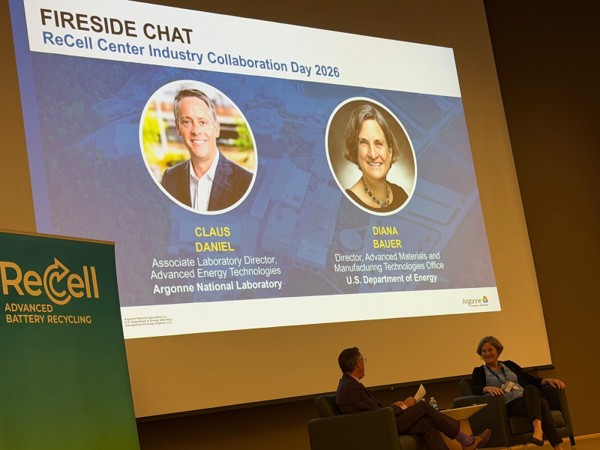
A fireside chat at the ReCell CenterIndustry Collaboration Meeting 2026 with Claus Daniel, Associate LaboratoryDirector for Advanced Energy Technologies at Argonne National Laboratory, andDiana Bauer of the U.S. Department of Energy.
Why supply chains are watching
Recycling sits at a sensitivepoint in the battery supply chain. Spent lithium-ion batteries are typicallyshredded into a powder called black mass, and for years much of the work ofturning that black mass back into usable battery material has taken placeoutside North America. Bringing that step closer to where batteries arecollected and built is now a priority across North America, Europe, and theAsia-Pacific region, driven by recycled-content expectations, critical-materialavailability, and the resilience of supply chains that span continents. One ofthe reasons the DOE stood up ReCell was to help grow a globally competitiverecycling industry and reduce reliance on foreign sources of battery materials.
Green Li-ion's own footprintreflects that global picture, with operations across the United States,Singapore, Korea, Germany, and Australia. Battery recycling is the link thatkeeps recovered nickel, cobalt, lithium, and graphite in circulation instead ofleaving the system. Getting it right, at cost and at scale, is what the ReCellcommunity works on.
The gap between the lab and commercial scale
If one theme runs throughReCell's work, it is commercialization. The chemistry of recovering metals fromold batteries is increasingly well understood. The harder problem is runningthat chemistry continuously, at commercial volume, at a cost that competes withnewly mined material. The distance between a validated laboratory process and aplant operating around the clock is exactly what the center's pilot-scaledemonstrations and licensing model are built to close.
That is also where the industryseparates ideas from infrastructure. Research lowers the risk in a process.Operators prove it can run.
Where Green Li-ion fits in battery recycling
Green Li-ion was built forexactly that commercial step. At Atoka, Oklahoma, American Li-ion has beenrunning Green Li-ion's technology since May 2024, and the plant is NorthAmerica's first commercial-scale facility designed to process unsorted black massinto battery-grade cathode precursor, lithium, and anode materials. Thepatented GREEN HYDROREJUVENATION technology converts black mass directly intothose battery-grade materials, and its modular design lets recyclers andmanufacturers either license the equipment for their own sites or send blackmass to Green Li-ion for tolling, which shortens deployment from years tomonths.
The process yields cathodeprecursor (pCAM) at 99 percent purity along with technical-grade lithiumcarbonate. Current capacity at Atoka runs at 2,000 metric tons per year, with afunded expansion to 8,000 metric tons per year underway. That is the commercialexpression of what ReCell's four focus areas point toward: recovering usablecathode material, keeping it in a working loop, and doing it at a footprint andcost that hold up against mined supply. The laboratory work and the plant floordepend on each other.
The gaps standing between recycling and critical-minerals security
Recovering material is only partof the picture. Real critical-minerals security through recycling depends onclosing several gaps that the current system still leaves open. Several of themwere on the agenda at this year's meeting, including a panel on the black massexport ban that Green Li-ion joined.
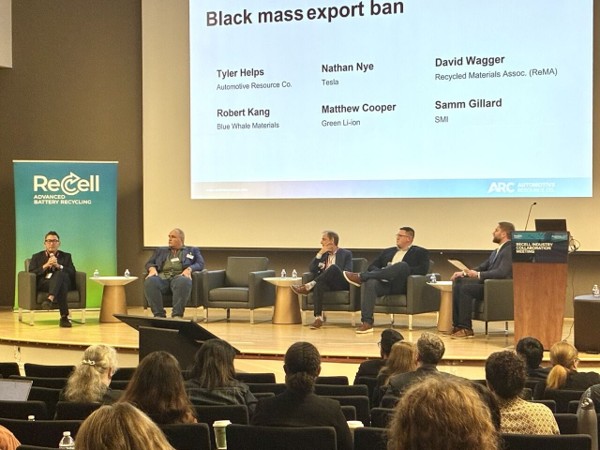
The black mass export ban panel at theReCell Center Industry Collaboration Meeting 2026, where Green Li-ion joinedthe discussion on how the new export rules affect recyclers.
The first gap is oversight ofthe whole scrap stream, not just black mass. The BIS Directive Allocation Orderthat took effect on August 27, 2026 restricts the export of black mass,requiring domestic sellers to allocate their monthly sales to U.S. buyersabsent prior authorization. Black mass is the shredded, cathode-bearing outputof the first stage of recycling. The feedstocks that sit upstream of it,production scrap and end-of-life batteries, are not covered by that order,which means critical minerals can still leave the country inside those forms ofscrap. That gap can also work against the companies that invested in domesticblack mass production, since their output is directed to the home market whilethe raw material that feeds it can still be sold abroad. Closing the loopdomestically means accounting for the whole stream, from production scrap andend-of-life packs through black mass and the refined products beyond it.
The second gap is refiningcapacity past the black mass stage. Producing black mass is now wellestablished in North America. Turning it into the refined intermediates thatbattery manufacturing actually consumes, cathode precursor, lithium carbonate,mixed hydroxide precipitate, and graphite, is a far narrower capability. GreenLi-ion's Atoka plant produces battery-grade cathode precursor andtechnical-grade lithium carbonate at commercial scale, but the wider ecosystemneeds much more of this post-treatment refining. There are still very fewproducers of finished cathode active material in North America, so recoveredmaterial can still travel offshore for the final refining steps that feedlithium-ion battery production. More investment in domestic intermediate andcathode production is what turns a shredding industry into a supply chain.
The third gap is graphite.Recovered graphite is not yet a serious part of the recycled battery materialstream, largely because graphite is inexpensive on the open market and theeconomics of recovering it are thin. It is also an at-risk material, and treatingit as an afterthought leaves a real vulnerability in place. Giving recycledgraphite the attention it needs will take deliberate demand, includingproducers and original equipment manufacturers choosing to specify recycledcontent in their battery chemistry rather than defaulting to the cheapestavailable source.
The fourth gap is demand itself.Recovered material only matters if it goes back into cells. Battery producersand automakers can accelerate the entire recycling economy by welcomingrecycled content into their proprietary chemistries and treating that choice assomething worth talking about. A recycled-content component is a realenvironmental credential, and manufacturers who build it into their batterieshave a story worth promoting to the customers buying their vehicles anddevices. Demand signals from the top of the chain are what pull recoveredmaterial back into use at the bottom.
The honest summary
ReCell 2026 was another markeron a clear path. Battery recycling is moving from proving that recovery ispossible to proving it can run at commercial scale and meet real demand. Realcritical-minerals security will take more than shredding capacity, though. Itwill take oversight of the whole scrap stream, far more domestic refining, realattention to graphite, and battery makers willing to pull recycled materialback into their cells. The research coordinated at Argonne lowers the risk inthat transition, and the companies turning that research into working plantsdetermine how fast it happens. Green Li-ion is one of the operators alreadydoing the commercial-scale part, converting black mass into battery-gradematerial at Atoka today.
Recyclers and manufacturersevaluating domestic recovery of battery-grade cathode and anode material canstart a conversation with the Green Li-ion team.

.svg)