
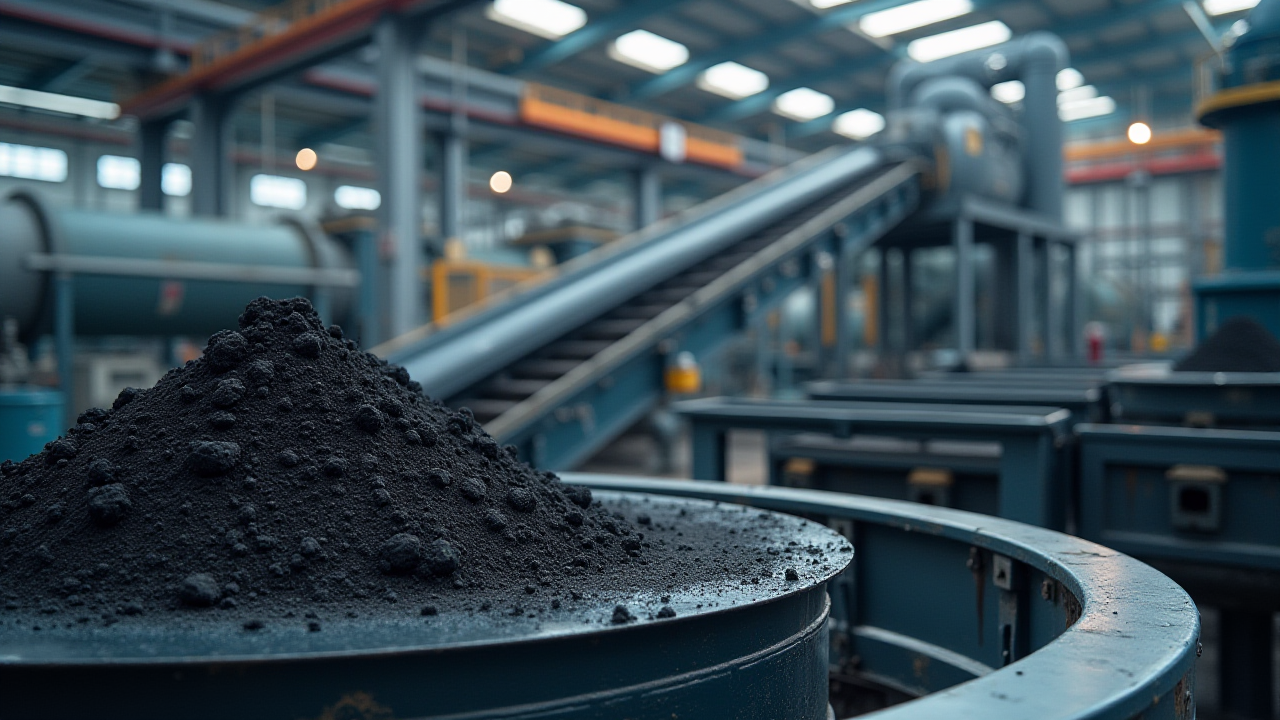
Every argument about whether the United States can absorb its own battery scrap after August 27 runs on the same set of numbers. Twenty thousand tonnes here. A hundred thousand tonnes there. Those figures are real, they come from company filings, and almost none of them measure what the conversation assumes they measure. Most published US black mass processing capacity numbers describe shredding throughput. The rule that takes effect this month does not create a shredding problem. It creates a refining problem, and the two are counted separately.
The scope of the restriction, including which codes the order actually reaches, is covered in our breakdown of the BIS Directive Allocation Order. This piece looks at the receiving end. If domestically generated material has to stay in the country, something inside the country has to be able to consume it.
What US Black Mass Processing Capacity Figures Actually Measure
Battery recycling in the United States is built in two stages, and the industry has always described it that way in its own regulatory filings.
The first stage takes packs, modules, cells, and cell manufacturing scrap and breaks them down. Casings, wiring, copper, aluminum, and steel come off. What remains is black mass, a powder carrying the cathode and anode active material. This stage is mechanical. It scales with shredders, separators, and floor space.
The second stage takes that powder and pulls the metals back out as defined chemical products. This stage is a chemical plant. It needs leaching circuits, solvent extraction or an equivalent separation route, precipitation, filtration, effluent treatment, and a permitting posture that a mechanical facility does not require.
Not every operator splits them. Green Li-ion's GREEN HYDROREJUVENATION™ process at Atoka, Oklahoma runs both stages on one modular line, which is why its capacity figures describe black mass consumption rather than shredder throughput. That is the exception rather than the pattern, and the pattern is what the national numbers describe.
The sequence is described the same way across the sector's own annual filings. One publicly traded US recycler's Form 10-K for fiscal 2025 puts it directly: shredded material is processed to produce black mass, which then goes through a bulk hydrometallurgical process to remove impurities and extract the valuable minerals. Those filings also note that black mass has become a readily tradable commodity, with quality and value varying widely depending on battery chemistry and residual impurity levels.
That second sentence is the one worth sitting with. Black mass became tradable precisely because the two stages could be split, and they could be split because a buyer existed somewhere else. From August 27, for domestically generated material, that buyer has to be in the United States.
The Two-Stage Architecture, in the Industry's Own Words
Registration statements filed with the SEC set the split out about as plainly as it can be put. One North American operator's F-4 describes a two-facility model in exactly these terms. One facility type processes battery manufacturing scrap and end-of-life batteries to produce black mass. A second facility type processes black mass to recover lithium carbonate, cobalt sulphate, and nickel sulphate. Two functions, described separately in the filings, because they are separate.
US black mass processing capacity gets misread the moment a number leaves a filing and enters a headline. A facility described in tonnes per year of battery feedstock is rated on what goes into the front of stage one. The black mass that comes out the back is a fraction of that mass by weight, and the capacity to refine it is a different figure that often does not yet exist at the same site.
A concrete example, without the name attached, since the point is about how the figure is read rather than about any company. One publicly traded US recycler's December 2024 Form 8-K, filed in connection with a DOE grant award, describes a planned second facility at approximately 100,000 tonnes per year of battery materials, five times the throughput of its first plant. Both of those figures are measured as battery feedstock entering the system. Neither states how much black mass the site can refine. The filings are available on EDGAR for anyone who wants to check the framing.
That is the pattern rather than an outlier. Battery materials into the system and black mass through a refining circuit are different measurements at different points in the chain, and the larger of the two is almost always the one that reaches the headline.
Figures measured at the right point look different. One US operator's Form 10-Q discloses a commercial demonstration plant scaling toward roughly 3,000 tonnes of black mass per year, a figure stated as black mass consumed rather than as battery feedstock received. Set that against a headline of 100,000 tonnes of battery materials and the order of magnitude between the two measurements becomes visible. Many operators do not disclose the refining figure separately at all, which is itself informative.
None of this reflects badly on any company. The filings are accurate and they describe what they say they describe. The problem sits downstream, in an industry conversation that treats feedstock throughput and black mass refining capacity as interchangeable when they are not. Anyone assessing where material can actually go should ask a supplier which measurement a stated capacity refers to, and at which stage it is taken.
What Federal Data Says About Whether Recovery Is Displacing Imports
If domestic refining had reached meaningful scale, it would show up in national materials accounts. It has not yet.
The US Geological Survey's Mineral Commodity Summaries 2026 puts net import reliance for cobalt at 79 percent of apparent consumption for 2025, with apparent consumption estimated at 9,600 metric tons. Secondary production, meaning cobalt recovered from purchased scrap, is estimated at 2,000 metric tons, and USGS reports that scrap-derived cobalt represented 25 percent of estimated consumption.
That 2,000 tonne figure needs a caveat that usually gets dropped. It covers all purchased cobalt scrap, and a substantial share of US cobalt consumption sits in superalloys for aircraft gas turbine engines rather than in batteries. Superalloy scrap recovery is a mature, decades-old industry. The number is not a battery recycling statistic and should not be quoted as one. What it does establish is that the total recovered cobalt stream, batteries and everything else combined, is small against imports.
Nickel tells a blunter version of the same story. USGS notes that excluding scrap entirely, US net import reliance for nickel would be close to 100 percent.
Read alongside the two-stage split, the picture is consistent. The country has built the capacity to make black mass. Turning that black mass back into metal units that show up in national accounts is the step that has not scaled.
Two Feedstock Streams, Two Different Clocks
Absorption capacity is usually discussed as if black mass were one stream. It is more useful to think of it as two, arriving on unrelated schedules. The distinction below is a framing device rather than a measured split, since no public dataset separates US black mass volumes by origin.
Cell manufacturing production scrap comes off gigafactory lines as offcuts, rejected electrode, and out-of-specification cells. It scales with domestic cell manufacturing rather than with vehicle retirements. Its chemistry should be well characterized, because the producer knows what went into it, and that generally makes it easier material for a refining circuit to handle. It also originates at a smaller number of larger sites than end-of-life material does.
End-of-life material follows the vehicle fleet. Packs entering the recycling stream today were built years ago, in chemistries that have since been superseded, and they arrive through collection networks with variable handling and variable documentation. The volume curve is steep but it is further out, and it is the stream that most capacity forecasts are drawn against.
A refining circuit that tolerates mixed chemistry without pre-sorting can take both streams on the same line, which removes the need to build separate capacity against two feedstock curves that peak years apart. Green Li-ion's lines are built for unsorted mixed-chemistry input for that reason.
The order applies to both. It is worth asking whether production scrap deserves more attention than it has received in the coverage so far. It is the stream with volume on the ground now rather than on a forecast curve, and it originates with a comparatively small set of identifiable domestic producers. Where any of those producers currently ships covered material abroad, whether to a third party or to an affiliated refiner, the compliance question arrives in weeks rather than years. Whether that describes many of them, or few, is not something published data answers.
What Removing the Export Bid Does to Pricing
Black mass does not trade on a posted price. It trades on payables, a negotiated percentage of the contained value of the recoverable metals, with deductions for impurity, moisture, and chemistry. Payables are set by competition among buyers.
Take a category of buyer out of the market and the mechanism is straightforward. The remaining bids set the price, and the seller's realization moves toward whatever the domestic buyer pool will pay. For anyone whose output is black mass, that is a negative. For anyone operating a second stage, it is an improvement in feedstock terms that was not earned by anything they built.
The honest limit on that observation is that nobody outside the trade data providers knows how much US-generated black mass was actually being exported, or to whom. The direction of the effect follows from the structure. The magnitude does not follow from anything published, and any specific number attached to it in the coming weeks should be treated as an estimate rather than a measurement.
There is a second-order effect worth watching. If domestic payables fall far enough, the economics of shredding itself come under pressure, because collection and pre-processing costs do not fall alongside them. A rule intended to keep material in the country could, at the margin, discourage the activity that generates the material in the first place. Whether that materializes depends on how quickly domestic second-stage capacity absorbs the volume, which brings the question back to the constraint this article started with: US black mass processing capacity, counted at the stage that matters.
Why the Second Stage Is Harder to Build
Three things make refining capacity slower to add than shredding capacity, and none of them are solved by capital alone.
The first is regulatory footprint. A hydrometallurgical facility handles acids and generates process effluent, which puts it in a different permitting category from a mechanical separation line. What that costs in time depends on the jurisdiction, the site, and whether federal funding attaches a federal environmental review to the project, so it is not a single number. It is a step that a shredding operation largely does not have.
The second is feedstock variability, and the sector's own filings flag it: black mass quality and value swing widely with the chemistry of the incoming battery and the impurity load left by shredding. A refining circuit tuned for one feed profile does not automatically handle another. Conventional plant design answers this with pre-sorting, which pushes cost and complexity back upstream.
The third is scale mismatch. Large centralized refineries need committed feedstock volumes to justify their capital, and those volumes need to arrive on a schedule that matches the construction timeline. When the feedstock curve and the construction curve diverge, the capital is already committed and the plant still has to be finished.
Modular capacity addresses all three, which is the reason it exists. A modular line presents a smaller regulatory footprint than a large centralized refinery, in emissions, effluent volume, and site impact. Mixed-chemistry tolerance removes the variability problem rather than pushing it upstream into pre-sorting. And capacity added in increments does not require a feedstock commitment years ahead of the material arriving, because the next line gets built when the volume justifies it rather than in anticipation of volume that may not appear.
This is where post-treatment refining capacity becomes the constraint that matters. The order does not require anyone to shred more. It requires that domestically generated black mass finds a domestic buyer, and the only buyers that count are the ones with a working second stage.
What This Means for Anyone Holding Black Mass on August 27
The practical position divides cleanly.
If your output is black mass, the export bid you were pricing against is now conditional on a discretionary grant from BIS, with the burden on you as applicant. Your realistic buyer list is limited to domestic operations with functioning refining capacity, and that list is shorter than the headline capacity figures suggest.
If you operate a second stage, the feedstock competition you were facing from overseas buyers has been removed by regulation for the duration of the order.
Green Li-ion's approach at Atoka, Oklahoma compresses the two stages rather than separating them. GREEN HYDROREJUVENATION™ takes unsorted black mass of mixed chemistries and runs a single-step conversion from black mass to pCAM at 99 percent purity, producing four finished products from one line: precursor cathode active material, technical-grade lithium carbonate, recycled graphite, and NCM hydroxide. The lines are modular, which changes what the deployment question looks like. Adding capacity becomes a question of how many lines and where, rather than a question of whether a single large facility reaches completion.
The feedstock tolerance matters as much as the throughput. A circuit that handles mixed chemistry without pre-sorting sidesteps the variability problem that makes conventional second-stage capacity difficult to run against a scrap stream nobody controls.
Procurement and operations teams evaluating where domestically generated material can actually go before August 27 can begin partnership conversations with qualified recyclers such as Green Li-ion, which operates second-stage refining rather than pre-processing alone.
The Honest Summary
Most published US black mass processing capacity figures measure stage one. They describe how much battery feedstock enters a shredding operation, not how much black mass a hydrometallurgical circuit can consume. Company filings are clear about the distinction. The wider conversation is not.
Federal data supports the same read from a different angle. USGS reports cobalt net import reliance at 79 percent for 2025 with roughly 2,000 metric tons of secondary production across all scrap sources, most of which is not batteries, and nickel import reliance near 100 percent absent scrap. Recovered material is not yet displacing imports at scale.
The second stage is harder to build because of permitting, feedstock variability, and the capital risk of committing to a large plant ahead of the feedstock curve. Modular capacity that tolerates mixed chemistry addresses all three, which is the structural argument for Green Li-ion's approach rather than a claim about anyone else's execution.
Two limits on this analysis. Publicly filed capacity covers publicly traded companies, and several substantial US recyclers are privately held and do not file, so nothing here is a census of national capacity. And the USGS cobalt secondary figure covers all purchased scrap rather than battery scrap specifically, which is why it appears in this article as context rather than as a battery recycling measurement. Anyone modelling absorption capacity should build from operator-level confirmation rather than from national aggregates or from headline throughput numbers.


.svg)