
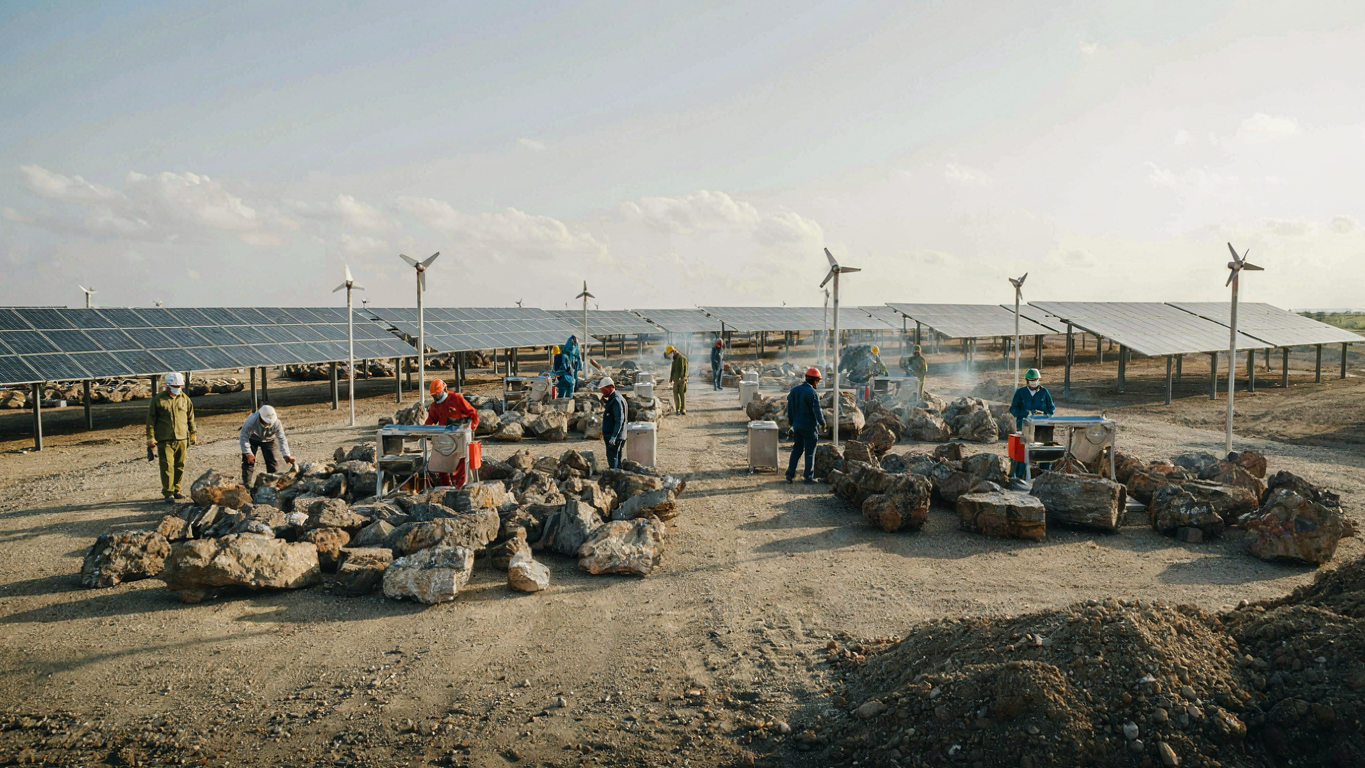
On July 16, 2026, Democratic Republic of the Congo Foreign Minister Thérèse Kayikwamba Wagner sat down with Fox News Digital on the margins of the United Nations Security Council and gave a line of guidance for anyone building against the DRC critical minerals supply chain: "I don't like talking about competition. I like talking about complementarity." Speaking earlier that week at a high-level UN meeting on critical minerals, Wagner warned that the global energy transition must not become "another extractive transition" that replaces one form of dependency with another. Her policy ask was concrete. Foreign partnerships should support local processing, infrastructure, technology transfers, research, industrialization, and access to financing, not simply secure raw supplies. For anyone reading that from the perspective of battery supply chain planning, Wagner has just described the exact procurement framework that battery recycling was built to satisfy. Commercial-scale hydrometallurgical recycling delivers local processing, transferable technology, industrial job creation, and battery-grade material inside the same jurisdictions that host end-use manufacturing. It is the operational shape of complementarity, and it is already an active contributor to the DRC critical minerals supply chain in the form of secondary material that offsets primary demand.
The DRC critical minerals supply chain conversation has been dominated by two framings. The first is a bilateral geopolitical contest between the United States and China over access to Congolese cobalt, copper, lithium, and tantalum. The second is a peace-through-minerals narrative tied to the Washington Accords of December 2025. Both framings underweight a third lens that Wagner's own words invite: recycling. Battery recycling is the fastest-scaling source of new cobalt, nickel, lithium, and manganese supply that does not require a new mine, does not depend on any single producing country, and produces battery-grade material inside the jurisdictions doing the manufacturing. It is also the piece of the DRC critical minerals supply chain conversation that has been quietly delivering results for years while the headlines focused on treaty signings. Wagner rejected the first framing on the record and pushed the second toward a substantive policy question about who actually captures the value of the minerals leaving DRC soil. Battery recycling operators need to understand where their model sits inside that framework, because the answer defines what a diligence-ready DRC critical minerals supply chain looks like in 2027 and beyond.
The DRC's Structural Position in the Global Cobalt Market
Any discussion of the DRC critical minerals supply chain has to start with the numbers. The U.S. Geological Survey's Mineral Commodity Summaries 2025 estimated that DRC accounted for 76 percent of world cobalt mine production in 2024, followed by Indonesia at 10 percent. China remained the leading refiner, and most of that refined cobalt was produced from partially refined material imported from DRC. In the United States, only the Eagle Mine in Michigan produced cobalt-bearing nickel concentrate in 2024, and even that concentrate was exported to Canada or overseas for processing. Domestic US cobalt supply consisted almost entirely of imports and secondary material from recycling, with cobalt content of purchased scrap representing 25 percent of estimated US cobalt consumption in 2024. This is the demand structure the DRC critical minerals supply chain interacts with globally.
Those numbers are the reason the DRC critical minerals supply chain is a strategic conversation in the first place. Concentration risk of this magnitude does not resolve through a single bilateral partnership. It resolves through a portfolio approach that includes primary DRC mining, primary mining from other jurisdictions, refining diversification, and recycling scale-up. Wagner's framing acknowledges this reality more clearly than most Western commentary on the subject.
Recycling is already inside the USGS baseline. The 25 percent share of US cobalt consumption sourced from purchased scrap in 2024 is not a projection. It is realized supply, produced from end-of-life batteries and manufacturing scrap that entered the domestic value chain without a shipment from any producing country. That share has room to grow substantially as electric vehicle fleets built between 2018 and 2024 reach end of life, as gigafactory scrap volumes rise, and as commercial hydrometallurgical capacity expands. Every incremental point of recycled cobalt in the DRC critical minerals supply chain reduces the volume of primary material that has to come from marginal artisanal or conflict-adjacent sources during periods of tight market conditions, which is the specific outcome the Strategic Partnership Agreement asks its signatories to work toward.
What the December 2025 Strategic Partnership Actually Commits To
The Strategic Partnership Agreement between the United States and the DRC, signed December 4, 2025, sets out cooperation areas covering critical minerals, energy, infrastructure, technology-driven initiatives, beneficiation, and industrialization. Two commitments inside that agreement are worth reading carefully because they shape how the DRC critical minerals supply chain will develop through the late 2020s.
The first is a joint commitment to "promote responsible mining practices in the Democratic Republic of the Congo, and support the formalization and industrialization of the artisanal mining sector, while actively working to reduce illicit trade in minerals, combat the use of critical minerals to finance conflict, and create alternative livelihoods for artisanal mining communities." The second is a joint commitment to "cooperate to develop the Democratic Republic of the Congo's domestic beneficiation capacity and assess opportunities for the DRC to participate in beneficiation projects outside of the country, including through equity ownership."
The Washington Accords for Peace and Prosperity, signed the same day between DRC and Rwanda under U.S. mediation, tie these economic commitments to the regional peace framework and to U.S. Development Finance Corporation investment interest. The Accords are the containing structure. The Strategic Partnership Agreement is the operational text. Wagner's UN remarks are the interpretive guidance from Kinshasa on how the DRC critical minerals supply chain should be understood by foreign partners.
Beneficiation is where the treaty language and the recycling case meet directly. Beneficiation, in mining vocabulary, means the processing steps that convert raw ore into higher-value refined material. In battery supply chain vocabulary, that is exactly what commercial-scale hydrometallurgical recycling does: it takes black mass, which is the concentrated cathode and anode material recovered from spent batteries, and converts it into battery-grade lithium carbonate, recovered graphite, and precursor cathode active material. The treaty commitment to develop DRC beneficiation capacity does not distinguish between beneficiation of primary ore and beneficiation of recovered secondary material. Both count. And both produce the same downstream outputs the global battery supply chain needs, which means the recycled route is a policy-eligible pathway inside the same framework that governs the primary route. That treatment matters because it means every commercial recycler serving Western markets is already contributing to the outcomes the DRC critical minerals supply chain agreement was designed to produce.
Why Battery Recycling Fits the DRC Critical Minerals Supply Chain Complementarity Framework
Wagner's specific asks map cleanly to what industrial-scale battery recycling delivers, and this is where the DRC critical minerals supply chain conversation and the recycling conversation intersect. Local processing, technology transfer, industrialization, and reduced pressure on artisanal mining are all outcomes that recycling scale-up produces at a system level, without competing with DRC primary production.
The scale point is important. Peer-reviewed research on cobalt recovery from lithium-ion batteries noted that 50 percent of cobalt is mined in the DRC and approximately 50 percent is refined in China, and framed recycling as the structural response to that concentration. Global mined cobalt production sits at approximately 240,000 metric tons per year. Recycling cannot and will not displace that primary supply, but it can materially reduce the incremental demand growth that would otherwise pull artisanal production into the value chain during periods of tight supply. Peer-reviewed longitudinal data on artisanal cobalt mining published in Science showed that artisanal mining's share of world cobalt has generally decreased since 2008, but that most artisanal production still moved through DRC-based Chinese processing or direct export to China. That is the trade recycling can most credibly complement.
The environmental case is now peer-reviewed as well. A January 2025 Nature Communications life cycle comparison of industrial-scale LIB recycling and mining supply chains established that circular supply chains produce materially different environmental and economic outcomes than conventional mining supply chains. A separate MDPI Sustainability life cycle assessment of the cobalt supply chain noted that LIB recycling potential for environmental impact reduction versus virgin cobalt could be substantial, and that as demand for cobalt continues to scale, recycling's share of production will grow. Green Li-ion has covered the operational implications in hydrometallurgical recycling advances for cobalt recovery, which detail how modular commercial lines convert unsorted black mass into battery-grade lithium carbonate, recovered graphite, and precursor cathode active material. That output flows into the same global market the DRC critical minerals supply chain feeds.
The Complementarity Case for Procurement Teams
Procurement teams building against the DRC critical minerals supply chain need a diligence position that Wagner's framing does not undermine. That position is complementarity. Recycled cobalt, nickel, and manganese from black mass do not displace DRC production. They provide a parallel supply line that reduces the volume of DRC output that has to come from marginal artisanal or conflict-adjacent sources during periods of tight market conditions. Battery manufacturers that source both DRC primary material and domestically recovered secondary material are demonstrating a portfolio approach that matches Wagner's own vision of the DRC critical minerals supply chain as one node in a multi-partner system.
This is the same argument that European recyclers have made for the past several years. Belgium-based recyclers demonstrated the value of European battery recyclers reducing DRC concentration risk through material flexibility, adjusting the blend of virgin and recycled inputs based on availability and economics. That flexibility becomes a strategic asset when concentrated primary supply faces disruption, as happened when the DRC implemented cobalt export restrictions in 2025 alongside African resource sovereignty and recycled supply policy shifts including Zimbabwe's lithium export suspension. Recycling did not compete with those national resource strategies. It made downstream manufacturers less vulnerable to them, which paradoxically reduced the pressure on producing nations to keep prices low to retain market access, and it strengthened rather than weakened the DRC critical minerals supply chain's long-term negotiating position.
The recycled cobalt in EV battery supply chains economics matter here. Cobalt is the metal whose recovery drives much of the value case for lithium-ion battery recycling, precisely because of its price, concentration, and social sensitivity. Buyers who can point to verifiable recycled cobalt content in their cathodes are hedging both regulatory and reputational risk, and they are doing so without needing to make claims about DRC sourcing that would misrepresent the reality of a market where DRC will remain dominant for the foreseeable future.
The Multi-Partner Model Wagner Called For
Wagner's most quoted line from the Fox News interview was a rejection of single-partner development: "A country as big as the USA, but also a country as big as the DRC and as big as China, they do not develop just with one single partner. They develop with different partnerships that respond to different needs and that bring different expertise to the table." That is the multi-partner critical minerals framework that has already emerged elsewhere in the market. The US built parallel bilateral arrangements including multi-partner critical minerals frameworks with Australia. The EU has its Critical Raw Materials Act partnerships. Japan and Korea run their own bilateral resource security programs. Recycling operators inside these frameworks are, at a system level, one of the "different expertise" contributions Wagner referred to.
Green Li-ion operates commercial modular hydrometallurgical processing lines in the United States, Singapore, Korea, Germany, and Australia. That footprint sits inside the multi-partner model Wagner described because it means recovered battery materials are produced inside multiple jurisdictions and enter multiple downstream battery supply chains without depending on any single country's primary production. It is the operational shape of a diligence-ready DRC critical minerals supply chain that includes recycled feedstock as a first-class input alongside primary mining. Procurement teams evaluating suppliers that fit the complementarity framework can begin partnership conversations with qualified recyclers such as Green Li-ion, whose GREEN HYDROREJUVENATION™ lines each produce up to 730 metric tons of recovered material per year and can be stacked at a single site to match demand from local battery manufacturers.
What to Watch Through the Rest of 2026
Three signals will define whether the complementarity framing holds. The first is the pace of DRC beneficiation development. If in-country processing capacity actually expands under the Strategic Partnership Agreement, the DRC critical minerals supply chain will move up the value chain, and the geographic distribution of refining will begin to shift. The second is whether the Washington Accords produce durable stability in eastern DRC. Wagner acknowledged the peace deal has not ended the violence, and continued M23 activity plus the coltan smuggling flows from areas like Rubaya remain live risks. The third is battery cathode chemistry evolution. If lithium iron phosphate and other lower-cobalt chemistries continue to gain share, DRC critical minerals supply chain demand dynamics will shift, and recycling will need to keep pace by adapting to the mixed feedstock streams that result.
None of these signals removes the need for recycling. Each of them reinforces the case for recycling as a permanent, complementary component of the global battery supply chain rather than a temporary bridge to some future all-mined supply. Wagner's language sits inside the same policy logic. The transition should not replace one dependency with another. The way to avoid replacement is to build multiple parallel supply lines. Recycling is one of them.
The honest summary
The DRC critical minerals supply chain is not something that outside partners can restructure by fiat. It is a national industrial base that supplies roughly three quarters of the world's cobalt, hosts a significant share of the world's copper reserves, and includes emerging lithium and tantalum positions that will matter more in the years ahead. Wagner's Fox News interview and UN remarks made three things clear. Kinshasa welcomes partnership. Kinshasa rejects the framing of that partnership as a zero-sum contest between Washington and Beijing. And Kinshasa expects partnerships to include local processing, technology transfer, and industrialization, not just offtake agreements.
Battery recycling operators reading that language should recognize their own value proposition inside it. Recycling reduces the demand pressure that would otherwise pull marginal artisanal production into stressed supply cycles. Recycling produces battery-grade material inside multiple downstream jurisdictions without depending on any single primary producer. Recycling gives OEMs and cell manufacturers a portfolio position that improves supply chain diligence rather than weaponizing it against DRC. And recycling scales inside the same regulatory and policy frameworks the DRC critical minerals supply chain now sits inside. The complementarity Wagner asked for is not a slogan. It is a description of the market structure the DRC critical minerals supply chain already sits inside once recycling capacity is counted correctly. What remains is for procurement teams, investors, and policymakers to count it correctly.

.svg)