
Every major critical minerals report published in the last twelve months tells the same story about rare earths, magnets, gallium, germanium, and antimony. The July 2026 Edge Consultancy report, the USGS Mineral Commodity Summaries 2026, the IEA Global Critical Minerals Outlook, and the CSIS analysis of Chinese customs data all document Chinese processing dominance running from 60 to 94 percent depending on the mineral. Graphite appears in all of these reports too, and it usually gets one sentence. The federal response has produced roughly a billion dollars in loans, grants, and tax credits for primary graphite projects, but none of it takes the form the rare-earth response has taken. There is no MP Materials-style federal equity stake in a graphite refinery. There is no Project Vault graphite allocation. There is no bilateral price-floor-plus-offtake package for graphite comparable to the arrangements Washington built for rare earths and lithium. Meanwhile, the recycled graphite supply chain is currently the only pathway producing battery-grade graphite on domestic soil at commercial scale, and it has received almost none of the federal support that has flowed to the primary graphite pipeline. That gap is the story this article unpacks. The recycled graphite supply chain is doing the work that the federal industrial policy conversation has not yet built the right tools for, and the manufacturers who position their anode supply around it early will get the best commercial terms when Washington's toolkit finally catches up.
What the Latest Critical Minerals Reports Skip About Graphite
The Edge Consultancy report published in July 2026 is a good example of the pattern. Its executive summary names graphite once, alongside gallium, germanium, antimony, and tungsten, as an area where China holds "commanding positions." Its escalation ladder tracks rare earths through the April 2025 controls, the October 2025 extraterritorial wave, the January 2026 measures targeting Japan, and the June 22, 2026 entity listing of MP Materials and USA Rare Earth. Graphite's own restrictions get one line. The underlying fact pattern for graphite is that the December 2023 controls on natural graphite products remain in force, an expanded set of controls on synthetic graphite anode materials and related equipment was announced on October 9, 2025 with a November 8, 2025 effective date, and those October 2025 additions were then suspended for one year to November 10, 2026 as part of the APEC de-escalation. The suspension window is temporary. The underlying legal architecture that allows Beijing to reactivate the anode controls with 24 hours' notice is intact. The Section 232 proclamation the Edge report highlights, with a status report due to the President on July 13, 2026, addresses processed critical minerals broadly but has not yet produced a graphite-specific instrument.
The reason for the imbalance is not analytical. It is that rare-earth magnets stop rotors from turning inside EV motors and defense platforms, and the political case for federal intervention writes itself. Graphite is the majority mass component of every lithium-ion battery anode ever manufactured at commercial scale, and it does not have the same optical urgency because there has not yet been a public production halt attributable to graphite supply. The absence of a crisis is often mistaken for the absence of a problem. In graphite the exposure is arguably larger than the rare-earth exposure, because the concentration of processing capacity is more extreme and the substitution options are narrower.
The graphite question sits underneath every part of the Edge report's analysis of AI, defense, and clean-energy demand growth. Data centers, EV production, and defense modernization all depend on lithium-ion energy storage. Every one of those batteries needs an anode. Every anode uses graphite. And every ton of finished battery-grade graphite currently entering North American cell manufacturing has either come out of a Chinese refinery or come out of a recycler. There is not yet a third option operating at commercial scale.
The Data: Graphite Processing Concentration Actually Exceeds Rare Earths
The published statistics on Chinese graphite processing dominance are, if anything, more concentrated than the rare-earth figures the federal response has been organized around. The US Energy Information Administration reported that China processes more than 90 percent of the world's graphite, alongside 85 percent of anodes, 82 percent of electrolytes, and 74 percent of separators. The International Energy Agency's Global Critical Minerals Outlook 2025 places China at the top of refining for 19 of the 20 strategic minerals it tracks, with an average 70 percent share, and confirms that the top three refining nations collectively hold about 86 percent of energy transition mineral processing capacity. Graphite is one of the tightest single-supplier concentrations in the entire dataset.
The IEA's July 2026 commentary on the reality of concentration risk quantified the specific graphite exposure. If Chinese battery-grade graphite trade were fully disrupted, more than $300 billion per year of downstream production outside China would be at risk. That is a graphite-specific number, not a rare-earth number, and it sits inside a $6.5 trillion total exposure figure that dominates the current geopolitical conversation. Graphite is roughly 5 percent of the total industrial value at stake in the US-China critical minerals confrontation, and it has almost none of the federal policy infrastructure that has been built to address the other 95 percent.
The USGS Mineral Commodity Summaries 2026 put the same picture in domestic terms. The United States is 100 percent net import reliant for 13 critical minerals and more than 50 percent reliant for another 20. Graphite sits inside that dependency profile. US processed metals imports more than doubled from $77 billion in 2024 to $185 billion in 2025 across the whole basket, and every additional ton of imported battery-grade graphite continues to concentrate rather than diversify the anode input market. Building out the recycled graphite supply chain is the only near-term route that materially changes the import-reliance number rather than accepting it.
Why the Federal Toolkit Has Not Yet Produced a Recycled Graphite Answer
Washington's response over the past two years has been the most assertive critical-minerals industrial policy mobilization in US history. The Edge report catalogs the moving parts. Project Vault, the $12 billion civilian strategic reserve launched in February 2026 as a public-private partnership with roughly $10 billion in EXIM financing and about $2 billion in private capital. Roughly $1.82 billion in Department of Energy support across fourteen projects. Around $400 million in Department of Defense manufacturing investment. Approximately $7.5 billion allocated for critical minerals under the One Big Beautiful Bill Act. Federal equity stakes in MP Materials, USA Rare Earth, Lithium Americas, and Trilogy Metals. Bilateral price-floor frameworks with Australia and Japan. A 54-country Critical Minerals Ministerial that launched the FORGE bloc in February 2026.
A meaningful share of that federal activity has touched graphite, but almost none of it has taken the form the rare-earth response has taken. NOVONIX has received a conditional DOE Loan Programs Office commitment for up to $754.8 million under the Advanced Technology Vehicles Manufacturing program for its Chattanooga synthetic graphite facility, plus a $100 million Manufacturing and Energy Supply Chains grant and selection for a $103 million investment tax credit. Anovion received a $117 million DOE Bipartisan Infrastructure Law grant for its Bainbridge, Georgia synthetic graphite plant. Syrah Resources received DOE grant support for the Vidalia, Louisiana processing facility and DFC financing for the upstream Balama mine in Mozambique. The American Active Anode Material Producers, a coalition of Anovion, Syrah, NOVONIX, Epsilon Advanced Materials, and SKI US, filed anti-dumping and countervailing duty petitions against Chinese graphite in December 2024.
What is absent is the specific rare-earth-style vertical package. There is no announced federal equity stake in a domestic graphite refinery. There is no Project Vault graphite-specific allocation currently disclosed. There is no price-floor-plus-offtake package for graphite comparable to the MP Materials arrangement. The Foreign Entity of Concern provisions of the Clean Vehicle Credit apply to graphite in theory, but the practical effect on domestic anode supply has been muted because the alternative supply does not yet exist at scale. The federal instruments that do exist have flowed almost entirely to primary graphite production, either synthetic graphite manufacturing (NOVONIX, Anovion) or natural graphite mining and downstream milling (Syrah, Westwater Resources' Coosa and Kellyton projects in Alabama). The recycled graphite supply chain has received almost none of the federal support that has flowed to the primary alternatives.
The primary graphite projects that federal policy has backed are all real, but almost all of them are also still ramping or pre-commercial. NOVONIX's April 2026 investor update indicated industrial-grade mass production targeted for 2026 and battery-grade material for Panasonic Energy in the second half of 2027, following qualification. Anovion Bainbridge is under construction. Syrah Vidalia is operational at limited scale, with an 11,250 tonne per year design capacity. Building refining capacity that can serve the anode active material demand implied by North American battery cell production, which the Department of Energy Vehicle Technologies Office projects will exceed 1,200 GWh per year by 2030 based on Argonne National Laboratory forecasting, takes years and, in the graphite case, has been slowed further by shifting policy signals. In the meantime, the only recycled graphite supply chain capable of putting battery-grade material into US anode production at commercial scale today is the one built on end-of-life battery feedstock and manufacturing scrap that already sits inside the country. The recycled graphite supply chain is currently operating alongside the primary alternatives federal policy is attempting to build.
The Recycled Graphite Supply Chain Is the Only Commercial-Scale Domestic Route Today
Recycled graphite has a specific structural advantage relative to the primary graphite supply chain. The feedstock is already inside the destination market, in the form of end-of-life EV and consumer batteries plus growing volumes of production scrap from the domestic cell manufacturing facilities ramping across Georgia, Tennessee, Kentucky, Ohio, and Michigan. It cannot be embargoed by a producing country because it did not need to be extracted. Its refining, if performed on domestic soil at battery-grade specification, delivers directly into cell manufacturing without a Chinese processing step at any point in the chain.
Peer-reviewed research over the past two years has documented the technical readiness of recycled graphite as an anode input. A 2025 Green Chemistry paper on low-energy in-situ recycling demonstrated 97.64 percent lithium recovery and 320.5 mAh/g specific capacity in regenerated graphite after 200 cycles, with 90.4 percent capacity retention. A 2025 Royal Society of Chemistry paper on environmentally friendly regeneration of graphite from spent lithium-ion batteries confirmed suitability for direct anode reuse. A 2026 MDPI review of graphite anode recycling summarized the technical, geopolitical, and economic case for domestic recycled graphite production. The technology stack that supports a functional recycled graphite supply chain is mature enough to build commercial operations around.
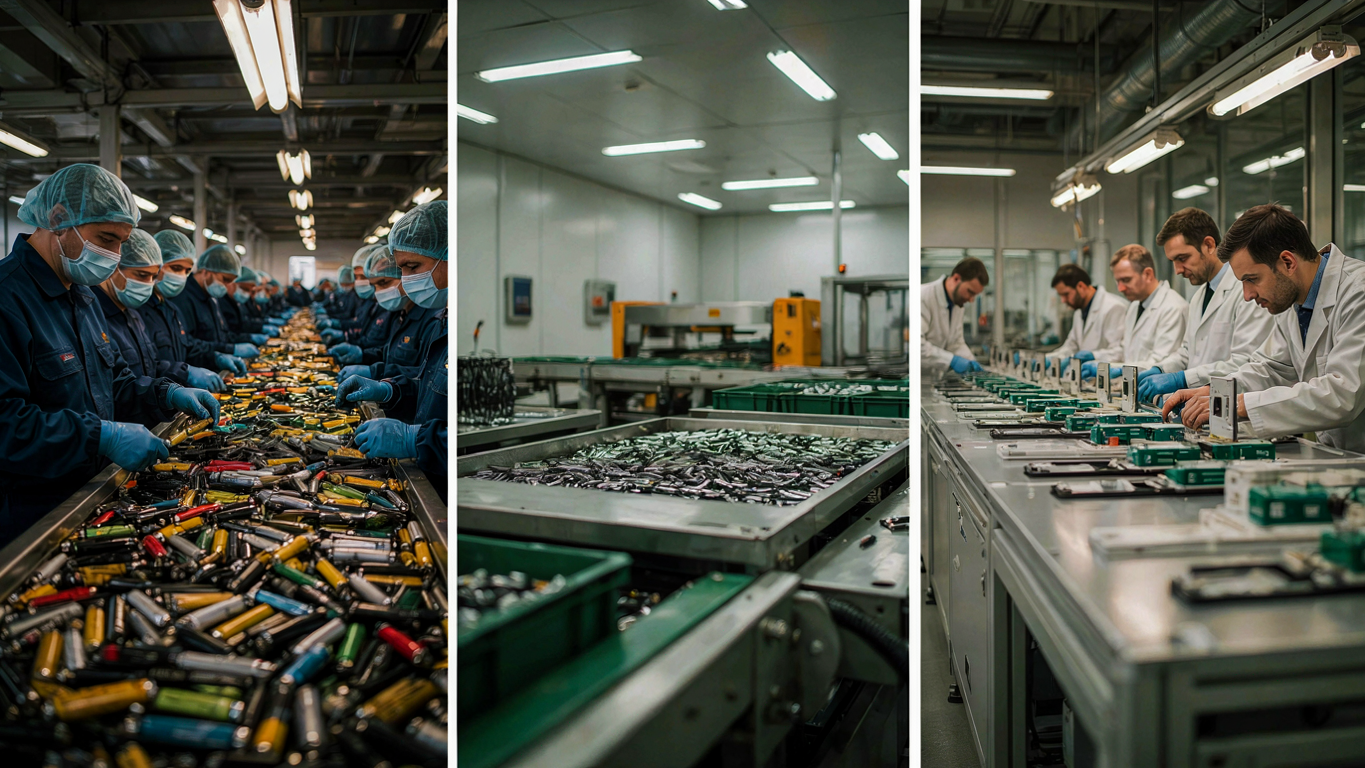
The operational proof point sits in Oklahoma. Green Li-ion's GREEN HYDROREJUVENATION™ process converts black mass directly into 99% pure pCAM, battery-grade lithium carbonate, and recovered graphite through modular processing lines running at 730 metric tonnes per year per line. The Atoka, Oklahoma facility processes unsorted black mass from mixed chemistries including NMC, NCA, and LFP, and it is currently one of the few operational commercial-scale sites in North America producing recovered graphite as part of a finished battery-grade output stream. The recycled graphite supply chain is not a future condition. It is producing today, and the current scale gap between recycled graphite supply and anode demand is what the next wave of federal policy needs to help close.
The Global Regulatory Convergence: EU, US, and Battery Passport Signals Align
Three regulatory environments are converging in a way that will make a mature recycled graphite supply chain more valuable in each of the next five years than it was in the last five. None of them singles out graphite for a recycled content mandate the way the EU Battery Regulation singles out lithium, cobalt, and nickel. All three of them nonetheless raise the commercial value of domestic recycled graphite supply.
The European Union's Battery Regulation 2023/1542 lists graphite as a critical raw material and requires the digital battery passport to disclose the material composition and origin of every battery placed on the European market. The regulation's recycled content mandates require battery-grade recycled material back in new cells for lithium, cobalt, and nickel starting 2031, with thresholds rising further in 2036. Graphite is not yet in the mandatory recycled-content list, but the underlying supply chain diligence and traceability infrastructure the regulation imposes applies to graphite the same way it applies to any other critical anode input. European cell manufacturers already need to prove where their graphite came from. As the EU Critical Raw Materials Act tightens through the late 2020s, that traceability requirement will accelerate the commercial value of a documented, non-Chinese, and specifically domestic recycled graphite supply chain.
The US Defense Logistics Agency solicitation for battery-grade lithium carbonate issued on July 2, 2026 signaled a broader federal shift toward treating battery materials as strategic assets rather than commodities. Green Li-ion's coverage of domestic supply chain localization and federal-tier material specification examined how DoD and DLA procurement is beginning to reward finished, domestic, specification-grade output over imported intermediates. There is no reason to expect graphite to remain outside that framework indefinitely. The Section 232 processed critical minerals proclamation with the July 13 status report deadline is the near-term mechanism through which a graphite-specific instrument could arrive.
The third convergence signal is OEM procurement. Ford, GM, Toyota, and several European automakers have publicly disclosed battery-input sourcing preferences that reward domestic recycled content and non-Chinese refining routes. Those disclosures have been more publicly documented for lithium, cobalt, and nickel than for anode graphite specifically, but the underlying procurement logic extends across the whole battery input basket. Cell manufacturers that need to demonstrate FEOC-compliant supply chains under the Clean Vehicle Credit cannot do so with a graphite input that finishes in China, regardless of where the upstream mining occurred. The finished battery-grade recycled materials distinction the July 20 sister article outlined applies to recovered graphite the same way it applies to pCAM and lithium carbonate.
What Anode Buyers Should Be Building Toward
For cell manufacturers, anode producers, and OEM procurement teams reading the Edge report and asking what its analysis actually implies for graphite specifically, the practical questions cluster around three themes.
First: how much of your current anode graphite input is refined in China, and what is your exposure if that supply is disrupted the way heavy rare-earth supply was disrupted from April 2025 through the end of that year? The IEA's resilience test is the frame here. If the single largest supplier were removed, remaining global supply would meet roughly half of projected 2035 demand for battery metals and rare earths, and a sustained shock could raise average battery-pack prices by 40 to 50 percent. Graphite carries a similar exposure profile.
Second: what non-Chinese refining capacity can you actually contract with in the next three years, and how much of that will come from primary versus recycled sources? Primary domestic graphite refining is scaling slowly. The recycled graphite supply chain is the only route that can add commercial-scale battery-grade supply on the timeline most cell manufacturers need it. Contracting recycled graphite offtake now, while the domestic recycling industry is still small enough that meaningful offtake commitments materially change the supply curve, is a different procurement decision than trying to buy recycled graphite spot in 2029 when EU demand pressure is fully priced in.
Third: does your recycling partner produce finished recovered graphite at battery-grade specification, or does it produce black mass that gets finished by someone else, potentially in China? This is the same distinction the Beyond Black Mass argument applied to pCAM and lithium carbonate. It applies to the recycled graphite supply chain the same way. Procurement teams ready to evaluate domestic recycled graphite supply can begin partnership conversations with qualified recyclers such as Green Li-ion, whose GREEN HYDROREJUVENATION™ process at Atoka produces recovered graphite as part of a finished battery-grade output stream at 730 metric tonnes per year per modular line. The company operates lines with a presence across the US, Singapore, Korea, Germany, and Australia, which matters for OEMs coordinating a global recycled graphite supply chain across their manufacturing footprint.
The Honest Summary
The Edge Consultancy report is a good synthesis of where the US-China critical minerals confrontation stands as of mid-2026, and its central finding is that the federal response has moved from rhetoric to concrete industrial policy in a way the sector has not seen before. That finding is correct. It is also incomplete. The instruments Washington has built are optimized for rare earths, magnets, and battery-cathode inputs, and there is no equivalent instrument for anode graphite specifically. Given that graphite processing is more concentrated in China than most of the minerals actually getting the federal attention, and given that the IEA has quantified the graphite-specific downstream exposure at more than $300 billion per year of production at risk outside China, the policy gap is going to close eventually. The question is which supply chain gets to close it.
The primary graphite mining and refining projects being built in Alabama, Louisiana, Washington State, Quebec, and Western Australia will get there in time, but the timeline is measured in years and the capex requirements are high. The recycled graphite supply chain is the only domestic pathway operating at commercial scale today, and it happens to sit inside a recycling process that also produces battery-grade pCAM and lithium carbonate as parallel output streams. Green Li-ion's GREEN HYDROREJUVENATION™ technology at Atoka is one operational proof of the model. Federal policy has not yet caught up to the fact that the graphite answer has been operating quietly while the rare-earth answer has been consuming most of the political attention. The manufacturers who position their anode supply around a domestic recycled graphite supply chain before that policy catches up will be the ones who get the best offtake terms when it does.


.svg)