
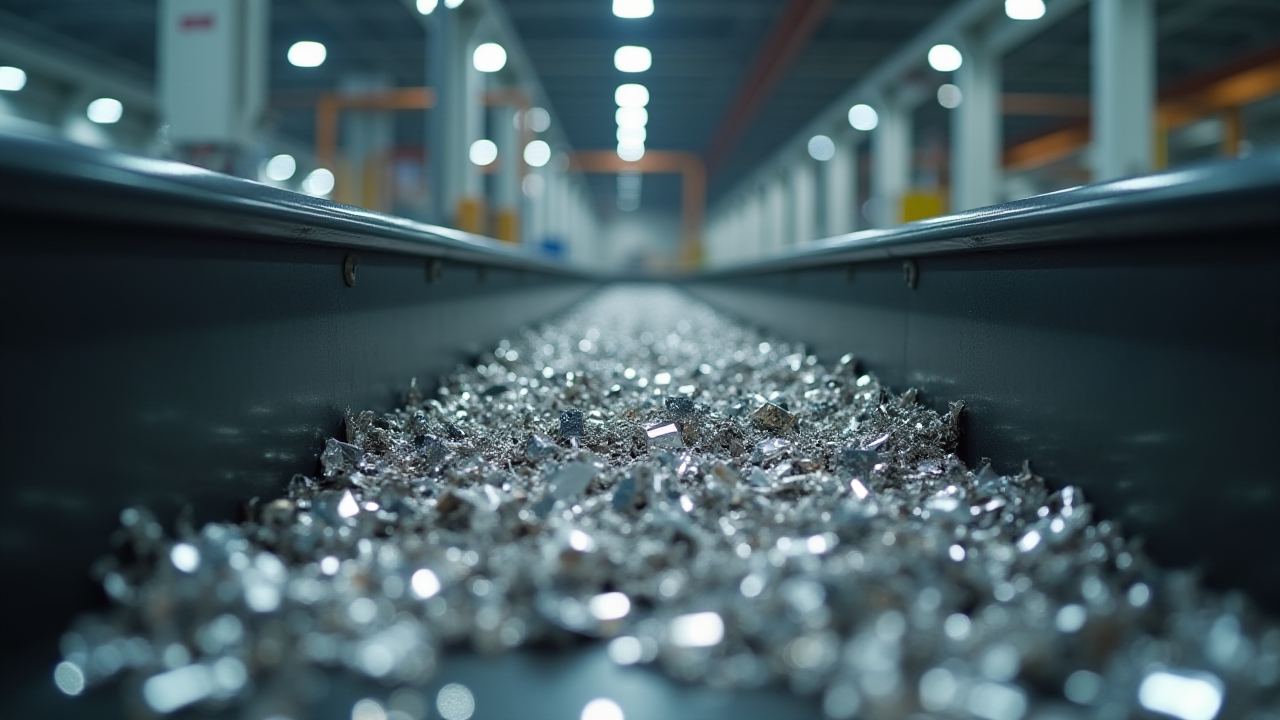
The Directive Allocation Order that the Bureau of Industry and Security published on August 6, 2026 is scoped by tariff classification rather than by concept. It reaches four black mass Schedule B codes and nothing beyond them. That structural detail decides which materials have to stay inside the United States after August 27 and which can still be sold into any market in the world. For recyclers, cell manufacturers, and procurement teams, the operative question is not whether recycled battery material is now restricted. It is which specific code a given product enters under.
The mechanics of the rule, the exception process, and the enforcement structure are covered in detail in our breakdown of the BIS Directive Allocation Order. This piece does something narrower. It works through the four covered codes line by line, explains why every one of them sits in a waste and scrap heading, and sets out where refined battery materials classify instead.
What the Black Mass Schedule B Codes Actually Cover
Table 1 of the new Supplement No. 1 to 15 CFR Part 700 lists four entries. That table is the complete scope of the order. There is no residual category, no catch-all for related materials, and no language extending the requirement to downstream products.
The first entry is Schedule B 8101.97.00.00, tungsten waste and scrap, carrying a 100 percent monthly domestic sales requirement. The remaining three are battery scrap codes. Schedule B 8549.13.00.00 covers electrical and electronic waste and scrap of primary cells, primary batteries, and electric accumulators, sorted by chemical type and not containing lead, cadmium, or mercury. Schedule B 8549.14.00.00 covers the same material unsorted. Schedule B 8549.19.00.00 covers the residual "other" category within that heading. All four codes carry the same 100 percent requirement, the same August 27, 2026 effective date, and the same August 27, 2027 expiration date.
The three black mass Schedule B codes carry a qualifier the tungsten entry does not. Each of the 8549 rows in Table 1 states that the sales requirement applies only if the waste and scrap meets the definition of black mass. The Bureau repeats the point in the preamble, stating plainly that materials under these Schedule B codes which do not meet the definition of black mass are not subject to the Directive Allocation Order.
That produces a two-part test. A shipment is covered only if it enters under one of the listed codes and the material meets the regulatory definition. Failing either filter puts the material outside the order. It is easy to collapse those two filters into a single claim that recycled battery material cannot leave the country. The rule as written does not say that.
Working through an example makes the structure clearer. A shipment of unsorted shredded lithium-ion battery fines entering under 8549.14.00.00 satisfies both filters and is covered. A shipment of shredded nickel-metal-hydride battery scrap entering under the same code satisfies the first filter but fails the second, because the definition is limited to lithium-ion chemistry. A shipment of nickel-cobalt-manganese hydroxide fails the first filter outright, because it does not enter under any of the black mass Schedule B codes in the first place. The order never reaches the second question for that third shipment.
Every Covered Code Sits in a Waste and Scrap Heading
Read the four descriptions in Table 1 together and a pattern emerges immediately. Heading 8101.97 is tungsten waste and scrap. Heading 8549 is electrical and electronic waste and scrap. The Bureau selected four codes, and all four are scrap classifications.
What the Bureau did not select matters just as much. Table 1 contains no code covering metal hydroxides, no code covering lithium salts, and no code covering chemical preparations of any kind. Every heading in the order is a scrap heading, and refined battery intermediates do not enter under scrap headings.
The correct code for any specific refined product is a question for CBP, and this article takes no position on it. The argument here is narrower and does not depend on that answer. Whatever code NCM hydroxide, pCAM, or lithium carbonate enters under, it is not one of the four the Bureau listed, and the order reaches nothing else.
The asymmetry between the tungsten entry and the battery entries reinforces the point. Tungsten waste and scrap is covered outright. Anything entering under 8101.97.00.00 is subject to the requirement with no further test applied. The three black mass Schedule B codes are covered conditionally, and the Bureau attached the qualifying language to each of them individually in Table 1 as well as restating it in the preamble. The Bureau stated that limitation four separate times, once in each of the three table rows and again in the preamble. Whatever the drafting history behind it, the text is not ambiguous. Heading 8549 is broad enough to capture battery scrap of chemistries the definition does not reach, and the qualifier is what keeps those outside the order.
This is consistent with the authority the order rests on. The July 30, 2026 Presidential Determination, which we examined in our analysis of why post-treatment refining became a structural advantage, addresses recoverable critical minerals and materials. The category it describes is the recoverable stream: black mass, end-of-life magnets, swarf, and other waste and scrap containing critical minerals. It is a policy aimed at keeping unrefined feedstock inside the country so that domestic capacity can process it. Extending the same restriction to finished refined output would work against that objective, because the finished output is the evidence that the domestic processing already happened.
Refined Battery Materials Are Not Shredded Scrap
The definition at paragraph (b) of Supplement No. 1 is the operative text. Black mass means any shredded lithium-ion battery scrap that contains cathode material, which may include aluminum, copper, iron, lithium, cobalt, nickel, and manganese, anode material such as graphite and silicon, or other residual battery cell materials.
Three conditions have to be satisfied. The material must be shredded. It must be lithium-ion battery scrap. It must contain cathode material, anode material, or residual cell material. Refined battery materials fail the first two conditions before the third is even reached.
Nickel-cobalt-manganese hydroxide, traded in most markets as MHP or mixed hydroxide precipitate, is produced by taking metal values into solution and precipitating them back out as a hydroxide under controlled pH. Peer-reviewed work in the International Journal of Energy Research and the Journal of Physics and Chemistry of Solids describes MHP as a hydrometallurgical intermediate feeding cathode synthesis rather than as a form of scrap. Both studies examine MHP produced from nickel laterite ore rather than from recycled feedstock, so neither speaks to battery recycling directly. What they establish is the material class. A precipitated hydroxide is a chemical intermediate, and that holds whether the metal values came out of an ore body or out of black mass. The material leaving the reactor bears no physical relationship to what went in beyond the elements it contains.
Precursor cathode active material goes further. pCAM is co-precipitated under controlled conditions that determine particle size, morphology, and metal ratio to a cell manufacturer's specification. Technical-grade lithium carbonate is a crystallized salt. Neither is shredded material in any sense the definition would recognize.
The distinction is not a technicality. It reflects what actually happens inside a refining facility. Green Li-ion's GREEN HYDROREJUVENATION™ process at Atoka, Oklahoma converts unsorted black mass directly into pCAM at 99 percent purity alongside lithium carbonate, recycled graphite, and recycled NCM hydroxide. Black mass enters the modular line. Four distinct chemical products leave it. The input is covered by the order. The outputs are different goods entering under different codes.
The Graphite Question
The definition names graphite explicitly, and that will stop anyone who produces recovered graphite. The wording repays close reading.
Graphite and silicon appear in the definition as examples of anode material that may be present inside shredded lithium-ion battery scrap. They describe what the covered material contains. They do not establish graphite as a separately covered good. A shredded black mass fraction containing graphite is covered because it is shredded lithium-ion battery scrap, not because graphite is on a list.
Recovered graphite that has been through a refining step and is sold as an anode-grade or industrial-grade product is not shredded lithium-ion battery scrap. It is a processed carbon product, and it does not enter under the 8549 heading. That reading matters commercially, because as we set out in our analysis of the recycled graphite supply chain, recovered graphite is among the small number of non-Chinese anode material streams operating at commercial scale in North America today.
There is a harder case in the middle. A graphite-rich fraction separated mechanically from black mass, without a chemical refining step, has a genuinely arguable classification. Anyone selling material in that category should obtain a classification opinion rather than rely on a general reading of the rule.
What Changes for Feedstock Suppliers and for Offtake Buyers
The order splits the market into two groups with opposite problems.
Companies whose output is black mass are holding the covered good. From August 27, every monthly sale has to go to a U.S. person unless the Bureau grants an exception. The exception grounds include a tolling pathway for material sent abroad for processing and returned to the United States, but the burden sits with the applicant and the outcome is discretionary. Where a business model has depended on an export bid being available, that bid is now conditional on a discretionary grant.
Companies that buy refined material face a different problem. Cell manufacturers and cathode producers in Korea, Japan, and Europe that were sourcing United States black mass have lost that channel unless their supplier secures an exception. The refined channel is unaffected. A buyer who previously imported black mass and refined it at home can instead buy the refined intermediate directly from a United States processor, and the goods that cross the border are no longer covered by the order.
The economics of that switch are not neutral. A buyer importing black mass keeps the refining margin at home but ships a lower-value intermediate and pays freight on the non-payable fraction that gets stripped out during refining. A buyer importing NCM hydroxide or pCAM gives up that margin and ships a higher-value product per tonne. Which side of the trade is better depends on the buyer's own refining position, and the rule does not settle it. What the rule has done is remove the option that made the first route reliably available.
European buyers have a second reason to look at that route, though the timing is further out than it is often described. Under Article 8 of EU Battery Regulation 2023/1542, binding minimum recycled content applies from 18 August 2031 for industrial, SLI, and electric vehicle batteries, set at 16 percent for cobalt, 6 percent for lithium, and 6 percent for nickel, with higher thresholds following in 2036. Our breakdown of the EU recycled content targets covers the phase-in. No minimum is in force today. Both give European cell producers reason to establish documented recycled supply well ahead of the deadlines, and a refined intermediate purchased from an identified processor is a more tractable starting point for that documentation than a bulk scrap shipment.
Green Li-ion operates at exactly that conversion point. The Atoka facility runs modular GREEN HYDROREJUVENATION™ lines, converting unsorted black mass of mixed chemistries into pCAM, technical-grade lithium carbonate, recycled graphite, and NCM hydroxide. Material from the plant is sold under a binding offtake agreement with commodity trader WMC running through 2030, and NCM hydroxide produced from American-recycled raw materials has been listed for direct commercial sale on the Metalshub platform. The company has a presence across the United States, Singapore, Korea, Germany, and Australia, which matters for manufacturers coordinating recycled supply across more than one jurisdiction.
Procurement teams evaluating domestic refined supply in advance of August 27 can begin partnership conversations with qualified recyclers such as Green Li-ion, whose output sits in the product categories the order does not reach.
The Limits of This Reading
Three qualifications belong alongside everything above.
Classification is determined product by product, and it is CBP that determines it. Nothing in this article establishes the correct code for any specific material. A company relying on the position that its output falls outside the black mass Schedule B codes should confirm its own classification with a customs broker or trade counsel, and consider requesting a binding ruling if the volumes justify it.
The order can grow. The Bureau states directly that it may determine additional materials identified in the Presidential Determination to be subject to an allocation order, and that it will announce any such expansion through publication in the Federal Register. The four covered codes are the current scope, not a permanent boundary. The Determination's underlying definition of recoverable critical minerals and materials is considerably wider than what this rule implements.
The definition of sale is broader than most readers assume. Under Supplement No. 1, a sale includes deliveries to affiliates and subsidiaries and deliveries between branches, divisions, or sections of a single entity under common ownership or control. A United States entity moving covered black mass to a foreign affiliate is making a covered sale. There is no internal transfer that sits outside the requirement.
Finally, this is descriptive analysis of a published rule rather than legal advice. Comments on the temporary final rule are due November 4, 2026 under docket BIS-2026-0364, and any company whose classification position is materially affected has a direct route to put that position in front of the Bureau.
The Honest Summary
The Bureau of Industry and Security restricted four Schedule B codes. One covers tungsten waste and scrap. Three cover electrical and electronic waste and scrap, and those three apply only where the material meets the regulatory definition of black mass as shredded lithium-ion battery scrap. Published at 91 FR 50701, the order runs from August 27, 2026 to August 27, 2027 with a 100 percent domestic sales requirement, enforced at the border by CBP.
Refined battery materials are not in scope. NCM hydroxide, pCAM, lithium carbonate, and refined recovered graphite are chemically distinct goods produced by transforming black mass, and they classify in chapters of the tariff schedule that the order never touches. That is not a loophole. It is the structure the Bureau chose, and it follows logically from an authority aimed at keeping unrefined feedstock available to domestic processors.
The practical consequence is that value-added processing on United States soil is the difference between a restricted good and an unrestricted one. Companies that shred and ship are holding the covered material. Companies that refine on domestic soil are holding something else. Green Li-ion's Atoka lines are one operational example of that second position, converting black mass into four finished products that leave the plant under codes the order does not list.
The caveats are real and should be treated as such. Classification is fact-specific and belongs to CBP. The Bureau has reserved the right to expand the order at any time. Internal transfers to foreign affiliates count as sales. Anyone whose commercial model depends on the distinction described here should verify their own position rather than rely on a general reading, and should consider filing a comment before November 4.


.svg)